Ring Size Chart: How to Measure Your Ring Size
US and Canada ring sizes with inside diameter and circumference in millimeters, UK letter equivalents, how to measure at home and when a ring can be resized.
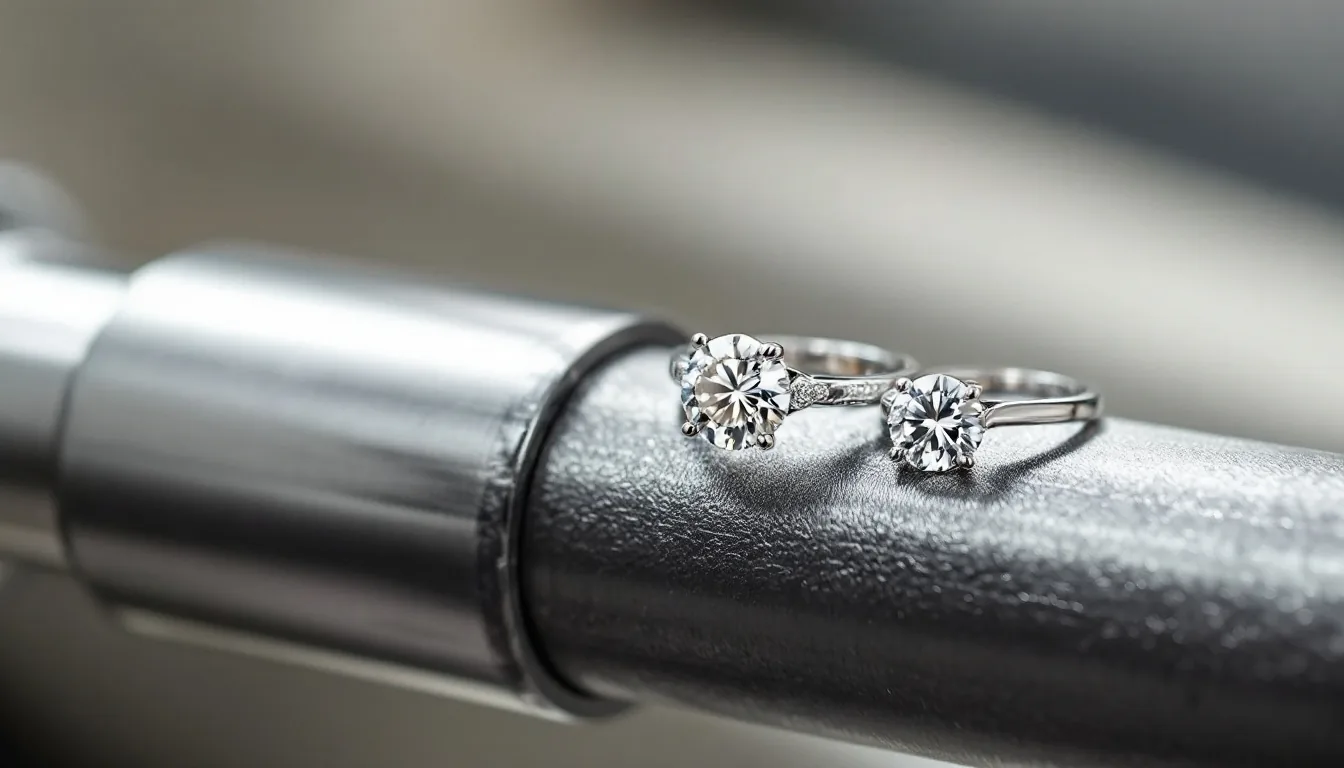
A US ring size is a measure of the inside of the ring: US size 6 has an inside diameter of about 16.5 mm and an inside circumference of about 51.8 mm, and each whole size up adds roughly 0.8 mm of diameter. The most reliable way to find a size is a jeweler’s metal finger gauge, tried at a normal room temperature, with the ring able to pass over the knuckle. Home methods work as a starting point if they are done carefully.
US and Canada ring size chart
The figures below come from the international ring size chart published by GIA. The US and Canada use the same numeric scale, in quarter and half steps. GIA’s chart groups the UK, Europe and Australia under the letter scale shown in the last column.
| US / Canada size | Inside diameter (mm) | Inside circumference (mm) | UK / Australia |
|---|---|---|---|
| 3 | 14.1 | 44.3 | F |
| 3½ | 14.5 | 45.6 | G |
| 4 | 14.9 | 46.8 | H |
| 4½ | 15.3 | 48.1 | I |
| 5 | 15.7 | 49.3 | J |
| 5½ | 16.1 | 50.6 | K |
| 6 | 16.5 | 51.8 | L |
| 6½ | 16.9 | 53.1 | M |
| 7 | 17.3 | 54.3 | N |
| 7½ | 17.7 | 55.6 | O |
| 8 | 18.1 | 56.9 | P |
| 8½ | 18.5 | 58.1 | Q |
| 9 | 19.0 | 59.7 | R |
| 9½ | 19.4 | 60.9 | S |
| 10 | 19.8 | 62.2 | T |
| 10½ | 20.2 | 63.5 | U |
| 11 | 20.6 | 64.7 | V |
| 11½ | 21.0 | 66.0 | W |
| 12 | 21.4 | 67.2 | X |
| 12½ | 21.8 | 68.5 | Y |
| 13 | 22.2 | 69.7 | Z½ |
The Ganoksin ring size chart gives the same diameters for whole and half sizes, with circumferences that differ from GIA’s by a tenth of a millimeter in places because of rounding. Reading down the table, each quarter size adds about 0.2 mm of diameter, so a whole size is about 0.8 mm of diameter or about 2.5 mm of circumference. That is a small amount, which is why the measuring method matters.
How to measure at home
From a ring that already fits
This is the better of the home methods.
- Pick a plain band that fits the intended finger comfortably. A wide or comfort-fit band can mislead, because its inside profile is not a simple cylinder.
- Lay it on a millimeter ruler and measure the inside diameter straight across the center, from inside edge to inside edge.
- Match the figure to the diameter column above. If it falls between two rows, note both and confirm with a jeweler.
GIA also suggests tracing the inside of a borrowed ring on paper with a sharp pencil when the ring cannot leave its owner for long. Note which hand and finger the borrowed ring is worn on. GIA notes that for a right-handed person the left ring finger is typically about half a size smaller than the right, and the reverse for a left-handed person.
With a paper strip or string
- Cut a narrow strip of paper that will not stretch. String is a poorer choice.
- Wrap it snugly around the base of the finger, then slide it toward the knuckle to check it would pass.
- Mark where the end overlaps, unroll it and measure the length in millimeters.
- Match the length to the circumference column.
Treat the result as an estimate. GIA warns that string can stretch, paper can tear, and humidity and temperature can make paper shrink and curl. A reading taken this way is best checked against a metal gauge before an order is placed for a ring that is hard to resize.
What changes the reading
Temperature and time of day
Fingers shrink in the cold and swell in the heat. According to GIA, a measurement taken on a winter day can differ from one taken in midsummer, and a cool morning reading can differ from an afternoon one. Humidity and altitude have an effect too. Ganoksin’s chart article recommends measuring at room temperature for the same reason. A sensible routine is to measure more than once, on different days, and not straight after exercise, a hot shower or time outdoors in the cold.
Band width
According to GIA, rings with wide shanks usually need to be a bit larger, because they fit more snugly. A wide band touches more of the finger, so the same inside diameter feels tighter.
Knuckles
A ring has to pass over the knuckle, which is often larger than the base of the finger. Measuring only where the ring will sit can produce a ring that will not go on. When the knuckle is much larger than the base, the usual answer is to size the ring for the knuckle and take up the slack at the base. Options such as sizing beads, sizing bars and hinged shanks are compared in Keeping Rings Upright: Sizing Beads, Bars and Other Fixes.
Resizing limits by metal and design
Resizing means cutting and adding or removing metal, or stretching and compressing the shank. Erhard Brepohl’s overview on Ganoksin notes that any stretching stresses the metal with a risk of the ring snapping, that rings with stones are not stretched on mandrels because the stones could be damaged, and that larger enlargements need a piece of metal inserted into the shank.
GIA’s ring material comparison gives these rough limits for plain rings without gems:
| Material | Resizable? (GIA, rings without gems) | Notes |
|---|---|---|
| Yellow, white or rose gold | Yes, up to about 2 sizes | White gold usually needs replating with rhodium afterward |
| Sterling silver | Yes, up to about 2 sizes | |
| Platinum | Yes, but expensive | Needs platinum solders or welding; see Platinum in Jewelry |
| Titanium | Limited to about half a size | |
| Tungsten | No | The ring has to be replaced if the size changes |
Design limits often matter more than the metal:
- Eternity and full-circle bands. GIA notes that rings with stones all the way around the band cannot be resized easily, because there is no plain shank to cut or stretch.
- Pavé and channel settings. These cannot be resized easily either. Working the shank puts the stones held along it at risk.
- Twisted and patterned bands. GIA describes these as difficult to resize, since a sizing seam interrupts the pattern.
- Tension settings. A true tension setting works as a spring. Bench jewelers on the Ganoksin Orchid forum advise against routine sizing, because cutting and joining the shank leaves hard and soft areas, and recommend sending the ring back to its maker, which has the equipment to restore the temper.
For any ring in this list, it pays to confirm the size with a gauge before ordering and to ask the seller about its sizing policy. Metal content also affects sizing cost; Gold Karats Explained covers how karat changes hardness and color.
Common questions
Is it better to order a ring slightly large or slightly small? Ganoksin’s sizing article suggests that when the exact size is uncertain, it is better to go larger. A slightly large ring can be fitted with sizing beads or a guard, while a ring that will not pass the knuckle cannot be worn at all.
Are ring sizes the same everywhere? No. The US and Canada share a numeric scale, and the UK and Australia use letters. GIA’s chart shows several other national scales, and some do not line up neatly with US quarter sizes, so the inside diameter in millimeters is the safest figure to give a jeweler abroad.
Why does a ring fit in winter but feel tight in summer? Fingers swell in heat and shrink in cold. A ring that is comfortable at room temperature is the best compromise for year-round wear.