Keeping Rings Upright: Sizing Beads, Bars and Other Fixes
Why top-heavy rings spin on the finger, and how sizing beads, sizing bars, spring inserts, Euro shanks and hinged shanks fix it, with pros and cons.
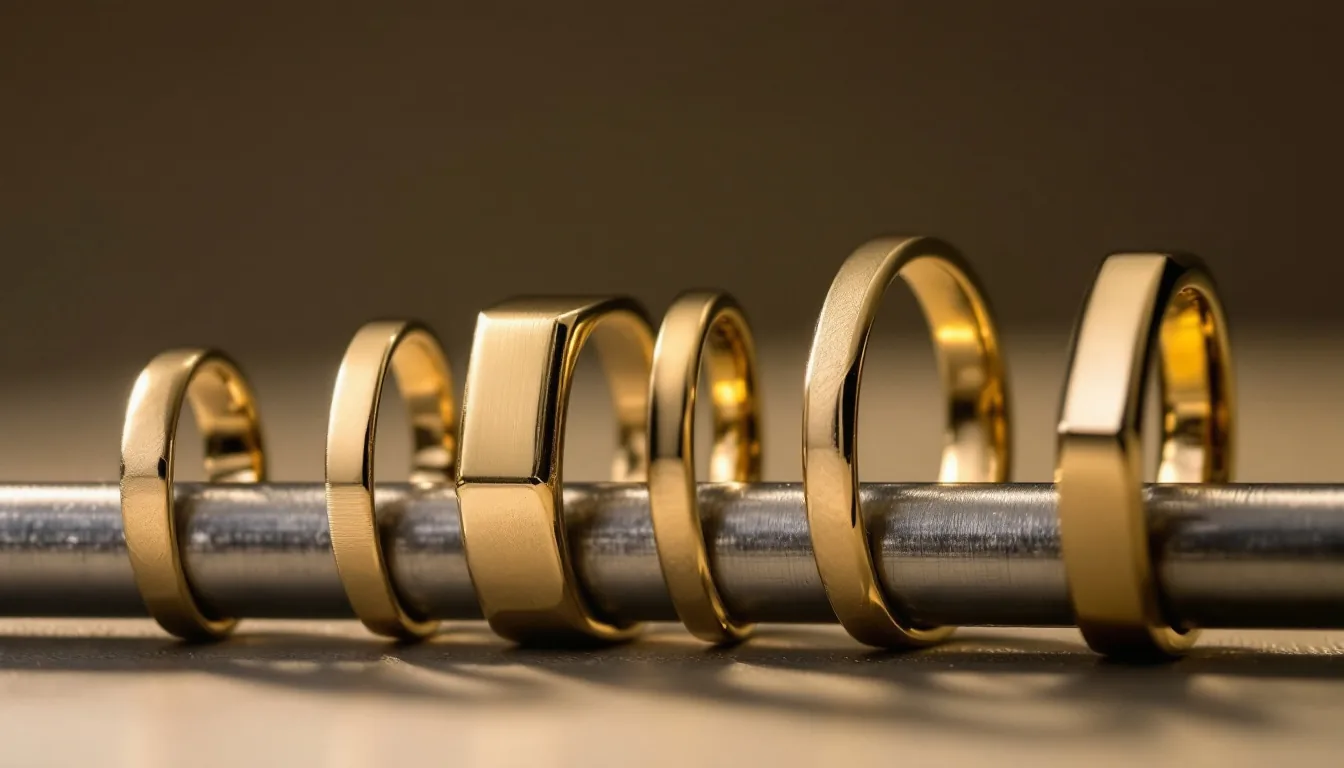
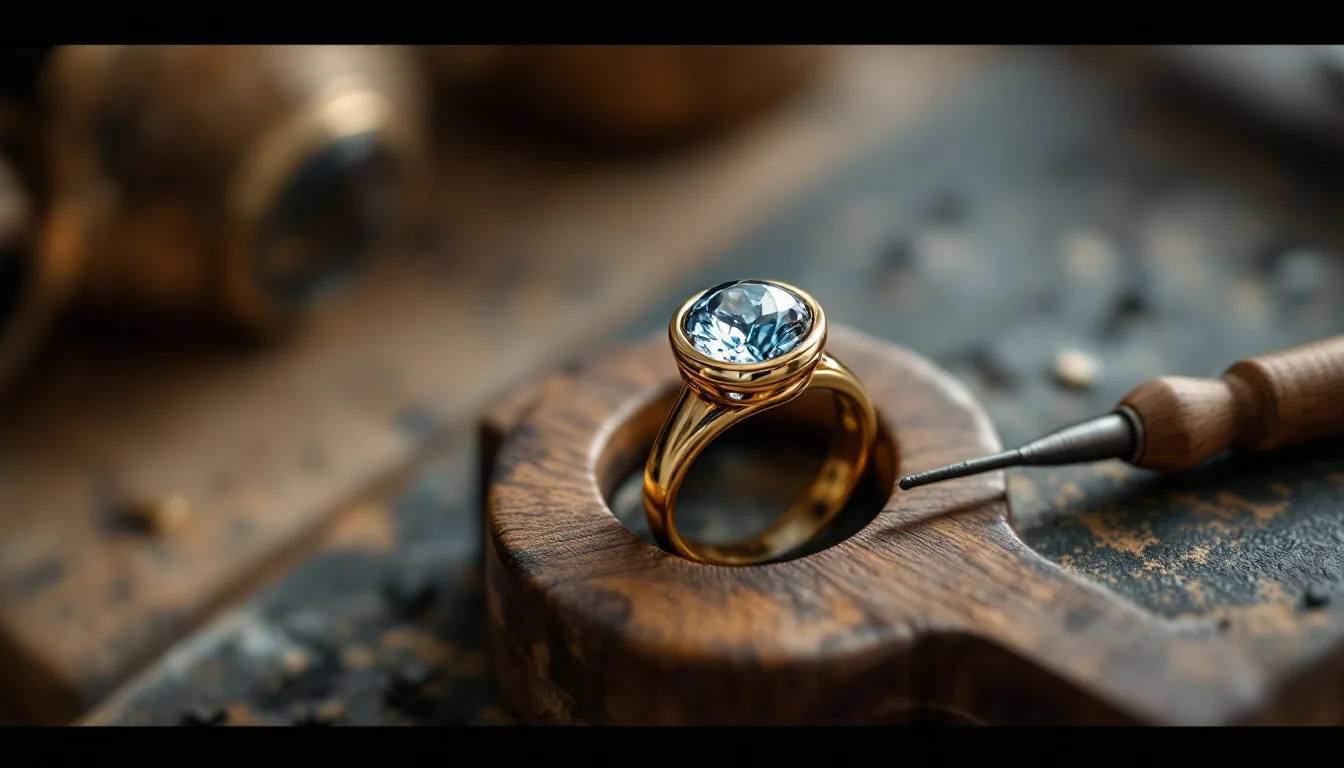
A ring spins when a heavy head sits on top of a band that is loose at the base of the finger. Gravity pulls the head toward the side, and a round shank offers nothing to stop it rolling. The fixes either take up the slack at the base of the finger, give the bottom of the shank a shape that resists rolling, or let the ring open past a large knuckle so it can be sized to the finger itself.
Why top-heavy rings turn
Three things combine:
- Weight distribution. A large center stone, a tall head or a halo puts most of the ring’s mass above the finger. A ring in that state is balanced like a pencil on its point: any looseness lets it tip.
- The knuckle. A ring has to pass over the knuckle, so it is often a size or more larger than the base of the finger. That gap is the room the ring needs to turn.
- Shank shape. A thin, round shank rolls easily on the soft underside of the finger, especially once it has worn thinner with age.
Before choosing a fix, measure the finger at the base and over the knuckle, and ask whether the wearer’s fingers swell in heat or cold or with arthritis. The size difference between knuckle and base usually decides the solution.
The options compared
| Fix | How it works | Advantages | Drawbacks |
|---|---|---|---|
| Sizing beads (balls) | Two small metal beads soldered inside the bottom of the shank | Inexpensive, quick, removable; the ring can still be turned over the knuckle | Some wearers find them uncomfortable; they make the ring a little harder to put on and take off |
| Sizing bar | A metal bar soldered across the inside bottom of the shank | Reduces the effective size; comfortable flat contact | The ring still has to pass the knuckle at its reduced size; fitting is trial and error |
| Spring insert | A spring of work-hardened gold, or a clip-in spring guard, inside the bottom of the shank | Flexes over the knuckle, then grips | Moving part; can loosen or catch; clip-in guards suit only some shank shapes |
| Plastic ring guard | A clip or coil fitted inside the band, no soldering | Cheap, reversible, good for temporary changes | Looks makeshift; can shift or discolor and needs replacing |
| Flat-bottom (Euro) shank | A squared or flat lower shank | Resists rolling; nothing added inside the ring | Means replacing or rebuilding part of the shank |
| Heavier lower shank | More metal at the bottom, by rebuilding or replacing the shank | Lowers the center of gravity | Adds weight and cost; heat near stones during the work |
| Hinged or adjustable shank | A mechanism that opens or expands to pass the knuckle, then closes | Ring is sized for the base of the finger; best for arthritis | Most expensive; mechanism needs occasional adjustment; limited metal and size ranges |
Sizing beads
Sizing beads cost little and can be undone, and Alan Revere’s ring-repair lesson, reproduced on Ganoksin, describes them as often the simplest solution. His method:
- Make two matching beads about 2 mm in diameter by fusing equal chips of gold scrap on a charcoal block with a little flux. The beads should match the ring’s alloy and color.
- Allow for the beads. Because they take up room inside the ring, Revere enlarges the ring by about a quarter size first, often just by hammering the shank lightly on a mandrel.
- Mark the positions at about 5 and 7 o’clock on the shank, looking at the ring with the head at 12.
- Solder the beads. Revere uses easy solder if the shank has earlier sizing seams nearby, and medium or hard solder if not. One variation seats each bead in a shallow depression cut with a ball bur.
- Finish and polish the inside of the shank so the beads are smooth and symmetrical.
The space between the two beads lets the wearer rotate the ring slightly as it passes over the knuckle, then the beads rest on the base of the finger. One Orchid forum contributor compares them to a keel: they do less to tighten the ring than to stop it rolling. They can be removed later and the shank refinished.
Sizing bars
A sizing bar is a short strip of metal soldered inside the bottom of the shank. Unlike beads, it actually makes the ring smaller, turning the inside from a circle into a flattened shape that sits against the soft underside of the finger. Contributors to Ganoksin’s Orchid forum note that there is no formula for sizing a bar. Bench jewelers measure the gap between knuckle and finger size, estimate the bar’s thickness and adjust after a fitting. Because the opening is reduced, a bar suits wearers whose knuckle is only slightly larger than the base of the finger.
Spring inserts and ring guards
A spring insert is a thin strip of springy metal fixed inside the bottom of the band. One Orchid contributor describes soldering in springs of work-hardened white gold. Commercial clip-in versions also exist. Esslinger’s specification for its white gold-filled spring ring guard says it reduces a ring by anywhere from three-quarters of a size to three sizes, installs by folding tabs around the bottom of the band, works on rings of finger size 5.75 or larger, and is not meant for shanks that taper significantly in width.
Plastic guards are a temporary measure, useful while a wearer’s finger size is changing, or to test whether a tighter fit solves the problem before paying for permanent work.
Changing the shank
When a ring is still at the design or remount stage, the shank itself is the best place to solve the problem. A Euro shank has a squared or flattened bottom that sits stably instead of rolling; an Orchid contributor recommends it for top-heavy rings that are not suited to an opening mechanism. Adding metal to the bottom of the shank lowers the ring’s center of gravity, which reduces the tendency to tip. Both changes mean cutting out the lower shank and soldering in new stock, so plan for the heat involved and protect or remove heat-sensitive stones.
Hinged and adjustable shanks
For wearers whose knuckles are much larger than their fingers, often because of arthritis, a mechanical shank lets the ring be sized for the base of the finger.
- Hinged shanks open completely. Stuller’s FAQ for the CLIQ system (formerly sold as SuperFit) describes pressing a stylus into a dimple to release the latch, wrapping the ring around the finger and closing it with an audible click. According to Stuller, the shank can be resized up or down by as much as one full size, by adding or removing metal at the bottom only, and the latch tension is adjusted with parallel pliers if it becomes too loose or too stiff.
- Expanding shanks slide open to a larger size but do not open completely. The Ganoksin lesson on installing an adjustable shank describes a sliding mechanism of this kind, which reduces the risk of the ring falling off while open.
Installing either type means sawing through the shank and soldering in the mechanism. The Ganoksin lesson warms a diamond ring slowly to avoid thermal shock to the stones and cools it slowly under a glass jar on a prewarmed charcoal block. Commercial mechanisms come in limited metals, widths and finger sizes, and Orchid contributors note that sterling silver lacks the spring tension that a latch or hinge needs.
Choosing the right fix
- Knuckle much larger than the base: a hinged or expanding shank, or sizing beads if the difference is moderate.
- Knuckle and base close in size, ring still spins: size the ring down, or add a sizing bar.
- Ring that cannot easily be sized, such as an eternity band: beads or a clip-in guard.
- Temporary change in finger size: a plastic or clip-in guard.
- New or remounted top-heavy ring: design in a flat-bottom or heavier lower shank from the start.
Safety note
Soldering beads, bars or mechanisms means working with a torch close to set stones. Check every stone’s heat tolerance, remove heat-sensitive stones or use a laser welder, and keep the flame moving to avoid hot spots. Work on a fire-safe surface with ventilation, wear eye protection, and handle hot pickle with copper or plastic tweezers.