Lab-Grown vs Natural Diamonds: Grading, Reports and Value
Lab-grown and natural diamonds are the same material. How HPHT and CVD stones are made, how GIA now reports them, inscriptions, FTC terms and value.
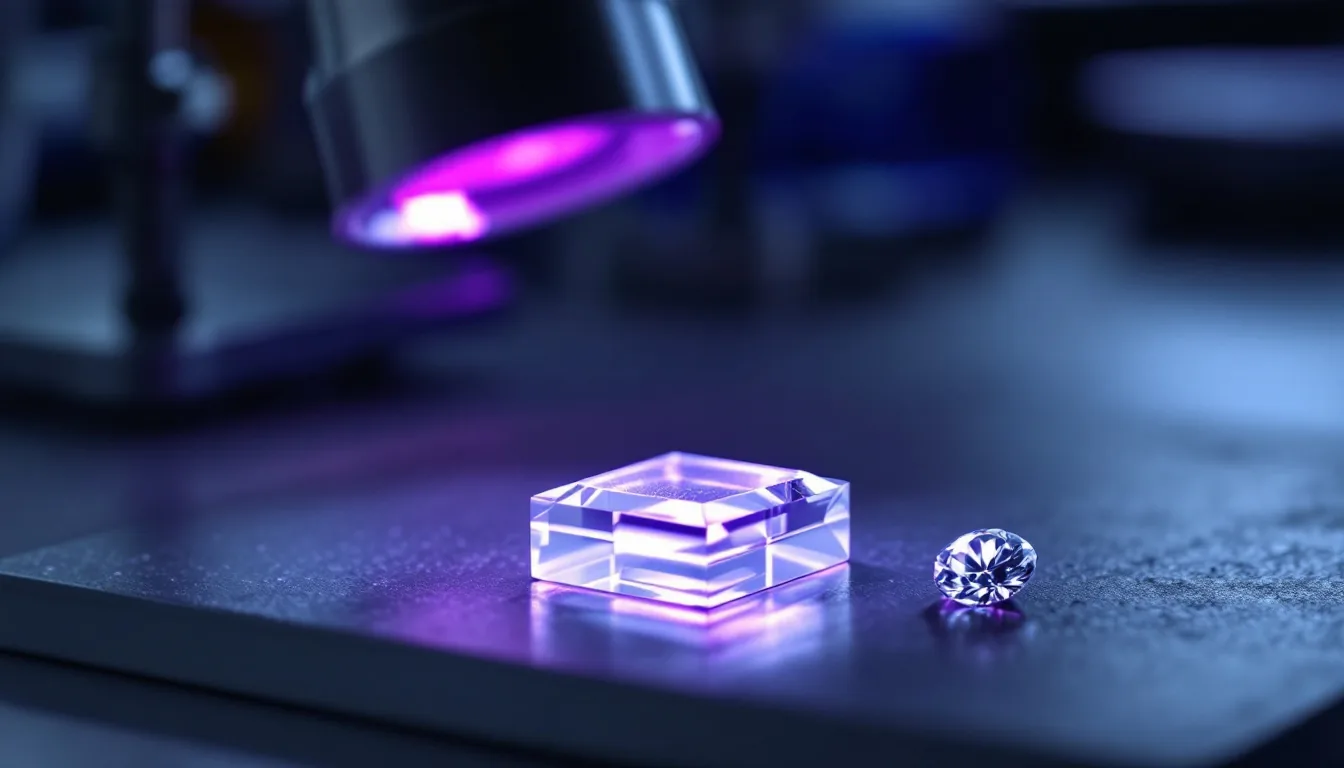
A lab-grown diamond is real diamond: crystallized carbon with essentially the same chemical, optical and physical properties as a mined stone. The differences are in how and when it formed, how laboratories report it, how it must be described for sale and how the market prices it. Lab-grown stones cost less than comparable natural diamonds, and that gap shapes their value over time.
Same material, different history
The FTC Jewelry Guides (16 CFR 23.12) define a diamond as a mineral consisting essentially of pure carbon crystallized in the isometric (cubic) system, with a hardness of 10 and a refractive index of 2.42. A laboratory-grown diamond meets that definition. GIA’s lab-grown overview puts it this way: the same crystal structure of tightly bonded carbon atoms gives nearly the same chemical, optical and physical properties.
What separates the two is growth history. Natural diamonds formed deep in the earth millions to billions of years ago. Lab-grown diamonds are made in a factory, and the process leaves traces in the crystal that a laboratory can read. That makes lab-grown diamond different from a simulant such as cubic zirconia or moissanite, which only looks like diamond.
How lab-grown diamonds are made
Two processes produce almost all gem-quality material. GIA’s 2024 review in Gems & Gemology summarizes both.
HPHT
High-pressure, high-temperature growth imitates conditions in the earth. Carbon is dissolved in a molten metal flux inside a press at about 5 to 6 GPa and 1,300 to 1,600°C, and crystallizes onto a diamond seed. A run takes from about an hour to a few weeks.
CVD
Chemical vapor deposition works at near-vacuum pressure. Hydrogen and a hydrocarbon gas flow over diamond seed plates, and a microwave-activated plasma breaks the gas apart so carbon deposits as diamond. Hydrogen makes up 90 to 99 percent of the gas mix and suppresses non-diamond carbon. GIA puts CVD growth temperatures at about 700 to 1,200°C.
CVD now dominates what GIA sees. Its 2024 review notes the institute receives more CVD-grown diamonds per day than it once did in a year, and that about 80 percent of CVD diamonds submitted since 2020 had undergone post-growth processing, often HPHT treatment to remove brown color.
Telling them apart
No loupe test or handheld thermal probe separates lab-grown from natural, since both are diamond. Identification relies on the growth features each process leaves. One clue is diamond type: GIA reports that all colorless lab-grown diamonds are type II, with no detectable nitrogen, while only about 1 percent of natural diamonds are. Labs confirm with spectroscopy and deep-ultraviolet fluorescence imaging. For the methods in detail, see How Lab-Grown Diamonds Are Detected and DiamondSure and DiamondView.
How grading reports differ
GIA’s change in 2025
GIA announced on June 2, 2025 that it would stop using its natural-diamond color and clarity terms for lab-grown stones. Its reasoning, from executive vice president Tom Moses, was that more than 95 percent of laboratory-grown diamonds entering the market fall into a very narrow range of color and clarity.
The new service launched on October 1, 2025. GIA now confirms the stone is laboratory-grown and places it in one of two categories:
| GIA category | Clarity | Color | Polish and symmetry | Cut grade (rounds only) |
|---|---|---|---|---|
| Premium | VVS or higher | D | Excellent | Excellent |
| Standard | VS | E to J | Very Good (symmetry Good for fancy shapes) | Very Good |
Stones that fall below the Standard minimums receive no GIA assessment. GIA lab-grown reports issued before the change carry D-to-Z color and clarity grades, so a buyer may see either format.
Other laboratories
Other gem labs issue their own lab-grown reports, and their formats and terms differ from GIA’s. The practical point for buyers: lab-grown grades from different labs, or from GIA before and after October 2025, are not directly comparable. Check which lab issued the report, its date and whether it states the growth method or any post-growth treatment.
For natural diamonds, GIA’s full scales still apply; see the Diamond Clarity Chart and the Diamond Color Scale.
Laser inscriptions
GIA inscribes the girdle of every lab-grown diamond it assesses with the words “Laboratory-Grown” and its quality assessment number. The 2024 review also notes that “LABORATORY-GROWN” inscriptions or manufacturer marks are common on the girdles of commercial-size products from other sources.
An inscription helps, but it is not proof. It sits on the surface of the girdle and can be missing, worn or, in rare fraud cases, falsified to match another stone’s report. A stone without an inscription, or one whose inscription does not match its paperwork, should be tested.
What the FTC requires
The FTC Jewelry Guides set the US rules for describing these products. In plain English:
- Qualify the word “diamond.” A lab-made diamond should be described as “laboratory-grown,” “laboratory-created,” “[manufacturer name]-created” or a phrase of like meaning, placed immediately before the word “diamond” and just as conspicuously, according to the FTC’s advertising guidance.
- “Synthetic” is allowed for real lab-made diamond. Under 16 CFR 23.25(c), “laboratory-grown,” “laboratory-created,” “[manufacturer name]-created” and “synthetic” may only be used with a stone’s name if the product has essentially the same optical, physical and chemical properties as the stone named. A simulant cannot be called a synthetic diamond.
- “Cultured” needs a qualifier. It may be used only alongside a clear disclosure such as “laboratory-grown” that the stone is not mined.
- No “real,” “genuine” or “natural.” 16 CFR 23.27 says these words should not describe a product that is manufactured or produced artificially.
- Simulants are different again. Stones that are not diamond need “imitation” or “simulated” directly before the word “diamond.”
This is a summary, not legal advice.
Lab-grown vs natural at a glance
| Factor | Natural diamond | Lab-grown diamond |
|---|---|---|
| Material | Carbon, cubic crystal | Same |
| Hardness and optics | Mohs 10; RI 2.42 | Same |
| Formation | In the earth, millions to billions of years ago | HPHT or CVD growth in a factory |
| Diamond type (colorless) | About 1 percent type II | All type II, per GIA |
| GIA report (since Oct 2025) | Full D-to-Z color and clarity grades | Premium or Standard category |
| Typical inscription | Report number, if inscribed | “Laboratory-Grown” plus number on GIA stones |
| FTC description | “Diamond” | “Laboratory-grown diamond” or equivalent |
| Price | Higher for comparable quality | Lower for comparable quality |
Price and resale
GIA describes lab-grown diamonds as offering high-quality options in new colors at a reduced price point, and says demand for them has risen in recent years. Two consequences follow for buyers:
- Lower entry price. A larger or higher-grade stone costs less as lab-grown than as natural.
- Uncertain resale. A product whose new price can fall puts pressure on what a used stone will fetch. Buyers who care about resale should ask a seller about buy-back or trade-in terms in writing rather than assuming them.
Neither product should be bought mainly as an investment. For insuring either kind, see Jewelry Insurance and Appraisals.
Common questions
Will a diamond tester flag a lab-grown diamond? No. Standard thermal testers respond to diamond, and lab-grown diamond is diamond. Separating the two takes a screening instrument or a laboratory.
Is a lab-grown diamond less durable? No. It has the same hardness of 10 and the same crystal structure, so it wears and is cared for the same way.
Why does my older GIA lab-grown report show a color grade? Reports issued before GIA’s October 1, 2025 change used D-to-Z color and clarity grades. Those reports describe the stone as it was graded at the time.
Further reading
- GIA 4Cs: Simulants, Moissanite and Lab-Grown Diamonds
- Gems & Gemology (Summer 2024): Laboratory-Grown Diamonds: An Update on Identification and Products Evaluated at GIA
- GIA: GIA to Use New Descriptive Terminology for Laboratory-Grown Diamonds (June 2025)
- GIA: Updated Laboratory-Grown Diamond Services to Launch October 1
- FTC Jewelry Guides, 16 CFR 23.12: Definitions and misuse of the word diamond
- FTC: In the Loupe: Advertising Diamonds, Gemstones and Pearls