DiamondSure and DiamondView: How Diamond Screening Instruments Work
How De Beers' DiamondSure and DiamondView separate natural from laboratory-grown diamonds, what replaced or joined them, and where screening ends.
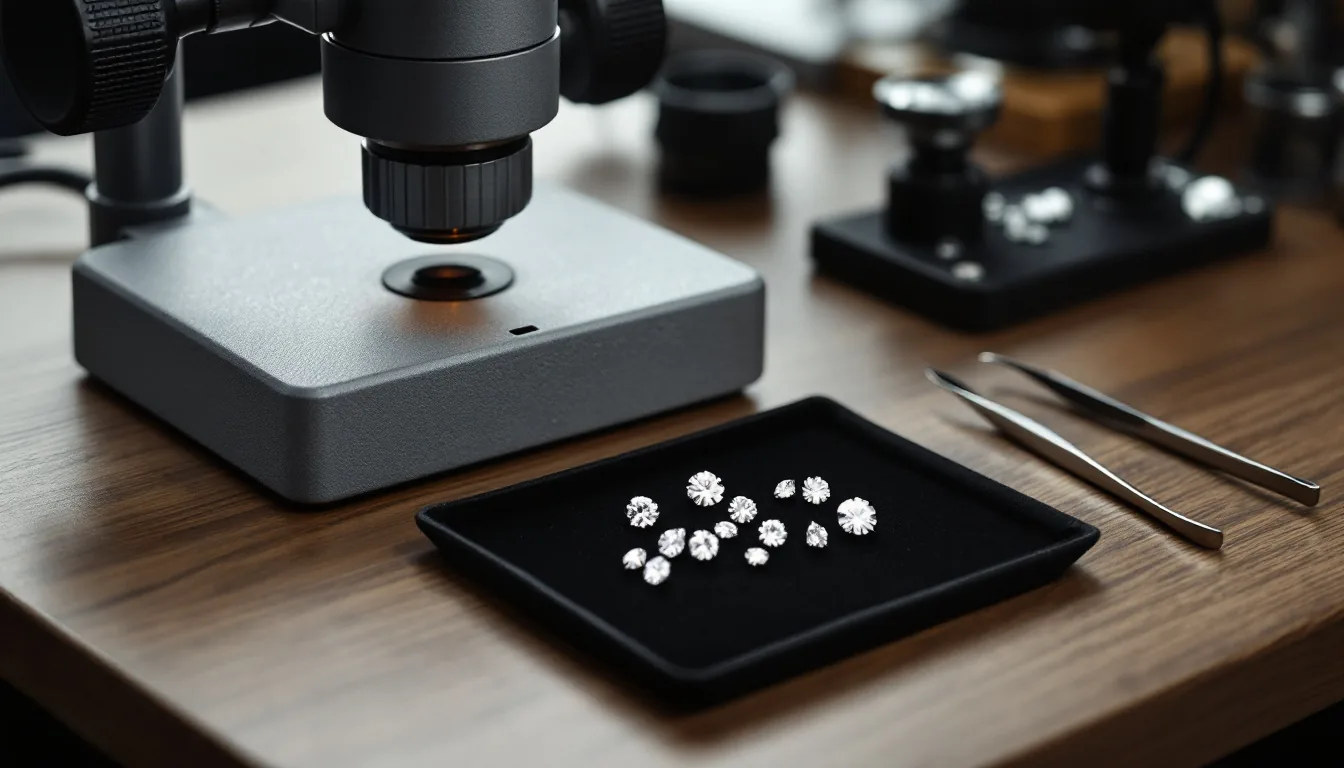
DiamondSure and DiamondView are a pair of instruments developed by De Beers to separate natural diamonds from laboratory-grown ones. DiamondSure is a fast screener: it measures how a polished stone absorbs ultraviolet and visible light and either “passes” it as natural or “refers” it for more testing. DiamondView is the follow-up: it photographs the stone’s luminescence under deep ultraviolet light so a trained operator can see how the crystal grew, which differs between natural, HPHT-grown and CVD-grown diamond.
Where the instruments came from
Both instruments were developed at the De Beers DTC Research Centre in Maidenhead, England, and were described by Christopher Welbourn, Martin Cooper and Paul Spear in the Fall 1996 issue of Gems & Gemology. Both were built to identify HPHT-grown synthetic diamond.
By 2004, De Beers researchers reported that improved versions were “in use in gemological laboratories worldwide” and commercially available from GIA Instruments UK Ltd. The same 2004 paper, by Philip Martineau and colleagues, tested both instruments against CVD-grown diamond, which was then the newer threat. Both instruments are still offered today by De Beers Group Ignite, alongside newer devices.
DiamondSure: absorption screening
DiamondSure looks for one specific clue. Most natural diamonds contain nitrogen in aggregated forms, and one of those aggregates, the N3 center (three nitrogen atoms surrounding a vacancy), produces a sharp absorption line at 415 nm. Laboratory-grown diamonds do not show it. DiamondSure records the stone’s absorption spectrum across the ultraviolet and visible range and checks for that line.
- Pass means the stone is a natural diamond and needs no further identification testing.
- Refer means the instrument cannot decide. The stone may be synthetic, a simulant, or a natural diamond that simply lacks the 415 nm line.
In the 2004 paper, tests on more than 300,000 natural diamonds and several hundred HPHT-grown synthetics showed that DiamondSure referred only 1 to 2 percent of natural diamonds but referred every HPHT synthetic. Every CVD sample in that study was also referred. De Beers’ current description is similar: about 98 percent of suitable stones pass, while synthetics, simulants and roughly 2 percent of natural diamonds (type II and type IaB stones) are referred.
The referred naturals are not a flaw so much as a consequence of the method. Type II diamonds contain little or no detectable nitrogen, so there is no N3 line to find. They are rare: in a large GIA study of D-to-Z diamonds, 99.06 percent were type Ia, 0.83 percent type IIa, 0.09 percent type IaB and 0.02 percent type IIb.
Practical limits
De Beers specifies DiamondSure for loose polished stones from 0.05 to 10 carats, mainly colorless and near-colorless. A detachable probe allows testing of mounted stones up to about 4 carats. The instrument can separate yellow synthetics from natural “cape” yellows, but De Beers does not recommend it for other fancy colors because referral rates are high.
DiamondView: seeing how a diamond grew
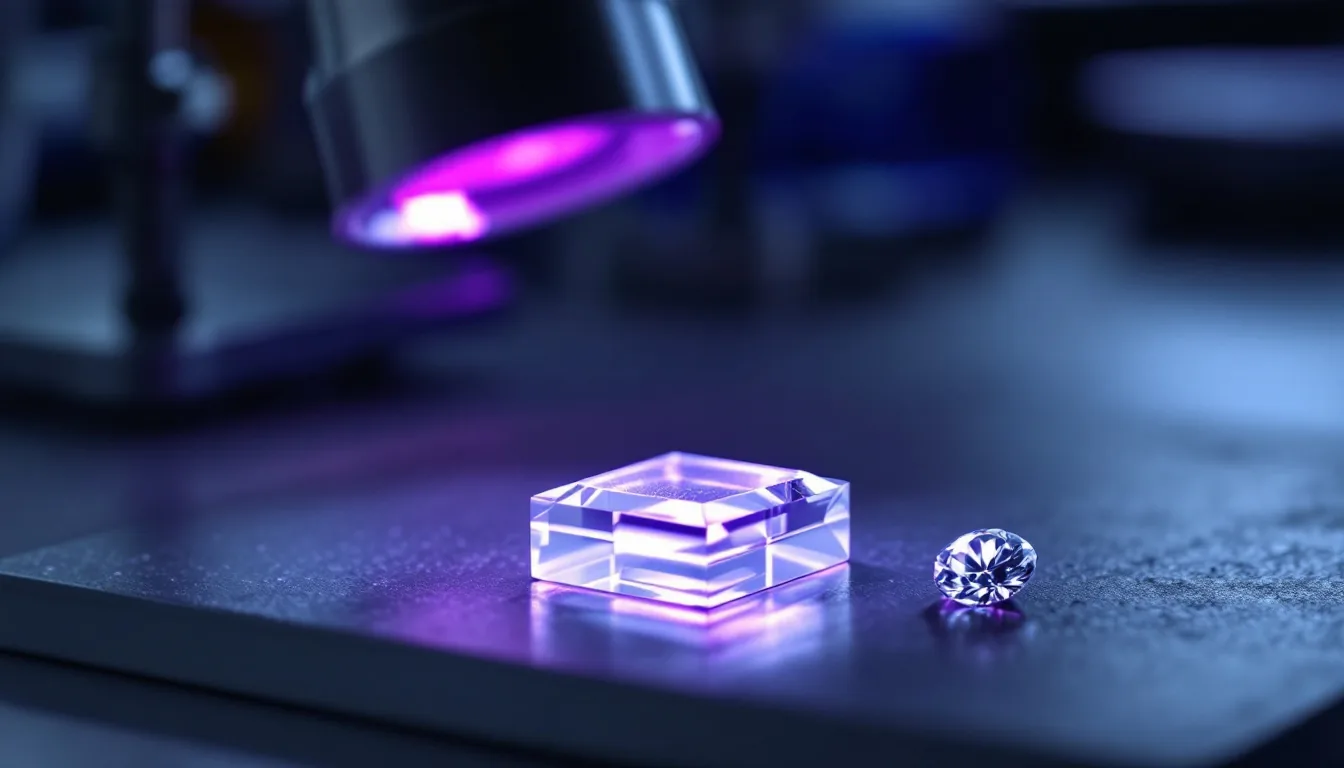
DiamondView exposes a polished stone to short-wave ultraviolet light and records a digital image of the resulting surface luminescence. It can also capture phosphorescence, the glow that continues after the light is switched off. The value lies in the pattern rather than the color alone, because each growth process leaves its own geometry.
| Origin | What DiamondView typically shows |
|---|---|
| Natural (type IIa) | Blue luminescence with a mosaic network of dislocations; plastically deformed stones show dislocations in slip bands |
| HPHT-grown | Cuboctahedral (blocky) growth sectors, often with strong, long-lasting phosphorescence |
| CVD-grown | Fine parallel striations, often clearest through the pavilion; nitrogen-doped stones glow orange to orangy red from nitrogen-vacancy centers, others pink, blue or greenish blue |
| CVD-grown, HPHT-treated | Green or green-blue luminescence that keeps the striated pattern |
The striations are the strongest CVD clue. Martineau and colleagues attributed them to uneven uptake of impurities on the steps of the growing surface and reported never having seen them in non-CVD diamond. They also noted that some rare natural type IIa diamonds show CVD-like orange luminescence, but those stones still reveal the dislocation networks typical of natural growth.
De Beers states plainly that DiamondView needs operator training, because the user has to capture and interpret the image. A high-magnification mode extends it to melee from 0.01 to 0.20 carats, and a changed holder allows some simple mounted pieces.
How the two work together
The instruments were designed as a two-stage protocol, and that is still how many labs and large dealers use them:
- Screen every colorless or near-colorless stone with DiamondSure (or another screener).
- Release stones that pass as natural; they go on to normal grading.
- Image referred stones in DiamondView to check growth structure.
- Where the image is unclear, add spectroscopy, such as infrared to determine diamond type and photoluminescence to look for defects linked to growth or treatment.
- Send anything still unresolved to a full gemological laboratory.
A third instrument from the same research program, DiamondPlus, was built to help detect HPHT-treated type II diamonds. As described in 2004, it took low-temperature photoluminescence measurements on stones immersed in liquid nitrogen, with each measurement taking about 20 seconds.
What joined them
Later devices filled gaps the original pair left open: melee, stones already set in jewelry, and lower-cost screening at the sales counter.
- PhosView (2016) and the AMS2 automated melee screener (spring 2017) came from De Beers’ International Institute of Diamond Grading & Research (IIDGR).
- SYNTHdetect, unveiled at JCK Las Vegas in June 2017, screens many stones set in jewelry at once. National Jeweler reported a price of $16,250 and a referral rate of about 0.05 percent.
- GIA iD100, which debuted at the same show, is a desktop unit using fluorescence spectroscopy. It screens loose and mounted stones down to about 0.005 carat in one to two seconds each, again with pass or refer results.
In 2019 the ASSURE Program, run by the Diamond Producers Association (now the Natural Diamond Council) and Signet Jewelers with testing by UL, evaluated 18 instruments from 11 manufacturers against 1,000 natural and 200 laboratory-grown samples. Rapaport reported that DiamondView was the only instrument to identify every natural correctly with no referrals, and one of two to identify every laboratory-grown specimen. More than two decades after it was first described, DiamondView was still the benchmark, and GIA lab notes continue to cite it.
The limits of screening
Screening answers one narrow question: is this stone definitely natural? A referral is not a finding that the stone is synthetic, and a screener will not tell you whether a natural diamond has been treated, what its color or clarity grade is, or where it was mined. Results also depend on correct use: clean stones, calibrated equipment and colors within the instrument’s range.
Laboratory growers keep refining their processes, too. GIA researchers reviewing CVD diamonds in 2016 concluded that reliable identification requires “a full complement of gemological, imaging, and spectroscopy instrumentation,” with DiamondView, infrared and photoluminescence spectrometers named specifically.
Screening versus laboratory identification
A screening result is an in-house decision tool. A laboratory report is an independent document based on the full range of tests above, run by staff who see large numbers of both natural and laboratory-grown stones. When a stone is referred, or when a deal depends on origin, the laboratory report is what settles it.
Disclosure follows the same logic. The US Federal Trade Commission’s Jewelry Guides treat it as deceptive to describe a laboratory-grown stone with the name of a natural gem unless that name is immediately preceded, with equal prominence, by a term such as “laboratory-grown,” “laboratory-created” or “[manufacturer name]-created.” Simulants must be described as “imitation” or “simulated.” A seller who has only screened a stone should not describe it with more certainty than the screening supports. This is a plain-English summary, not legal advice.
Further reading
- Gems & Gemology (Fall 1996): De Beers Natural Versus Synthetic Diamond Verification Instruments (Welbourn, Cooper and Spear)
- Gems & Gemology (Spring 2004): Identification of Synthetic Diamond Grown Using Chemical Vapor Deposition (Martineau et al.)
- De Beers Group Ignite: Diamond Verification Instruments
- Gems & Gemology (Fall 2015): Large Colorless HPHT-Grown Synthetic Gem Diamonds from New Diamond Technology, Russia
- Gems & Gemology (Fall 2016): Observations on CVD-Grown Synthetic Diamonds: A Review (Eaton-Magaña and Shigley)
- National Jeweler: De Beers Lab Introduces Screening Device for Set Jewelry (June 2017)