Diamond Clarity Chart: The GIA Clarity Grades Explained
All 11 GIA diamond clarity grades from Flawless to I3, the common inclusion types, how 10x grading works, eye-clean stones and how cut shape changes what you see.

Diamond clarity describes how free a diamond is of internal features (inclusions) and surface features (blemishes) when a trained grader examines it at 10x magnification. The GIA scale has 11 grades, from Flawless (FL) down to Included (I3). In the middle of the scale, the VS and SI grades, features are visible under a loupe but often not to the naked eye.
The 11 GIA clarity grades
GIA’s clarity page groups the 11 grades into six categories.
| Grade | Name | What a skilled grader sees at 10x |
|---|---|---|
| FL | Flawless | No inclusions and no blemishes |
| IF | Internally Flawless | No inclusions; blemishes only |
| VVS1 | Very, Very Slightly Included 1 | Minute inclusions, extremely difficult to see |
| VVS2 | Very, Very Slightly Included 2 | Minute inclusions, very difficult to see |
| VS1 | Very Slightly Included 1 | Minor inclusions, difficult to see |
| VS2 | Very Slightly Included 2 | Minor inclusions, somewhat easy to see |
| SI1 | Slightly Included 1 | Noticeable inclusions, easy to see |
| SI2 | Slightly Included 2 | Noticeable inclusions, very easy to see |
| I1 | Included 1 | Obvious inclusions |
| I2 | Included 2 | Obvious inclusions |
| I3 | Included 3 | Obvious inclusions |
At the I grades, GIA notes that inclusions are often visible without magnification and may affect transparency, brilliance and durability. The step from one grade to the next is a judgment about visibility and impact, not a count of inclusions.
Inclusions and blemishes
GIA draws a simple line between the two. Internal characteristics, and those that reach the surface from inside, are inclusions. Features confined to the surface are blemishes.
Blemishes usually matter less. In its clarity buying notes, GIA points out that many blemishes can be polished away and rarely affect grades below IF. Inclusions are part of the crystal and stay unless the stone is recut.
Common inclusion types
GIA’s inclusion glossary lists the terms that appear on grading report plots. The ones a retail customer is most likely to meet:
- Pinpoint: a very small crystal that looks like a tiny dot at 10x.
- Cloud: many tightly grouped pinpoints that together give a hazy patch.
- Crystal: a mineral crystal enclosed in the diamond. A white or transparent diamond crystal that reaches the surface after cutting is called a knot.
- Needle: a thin, elongated crystal that looks like a tiny rod.
- Feather: the trade term for a break in the stone, often white and feathery.
- Internal graining: distortion from irregular crystal growth that can affect transparency.
- Bearded girdle: very small feathers running in from the girdle surface, which can come from cutting.
- Chip, cavity and bruise: damage or openings at the surface, typically at the girdle edge, a facet junction or the culet.
- Indented natural: a bit of original rough surface dipping below the polished surface.
Two features point to treatment rather than nature. A laser drill-hole is a tiny surface-reaching tunnel made by a laser beam, and internal laser drilling creates or extends fractures so a dark inclusion can be bleached. The FTC’s jewelry advertising guidance lists laser drilling and fracture filling among treatments sellers may need to disclose, particularly where a treatment is not permanent, needs special care or significantly affects value. This is a summary, not legal advice.
How 10x grading works
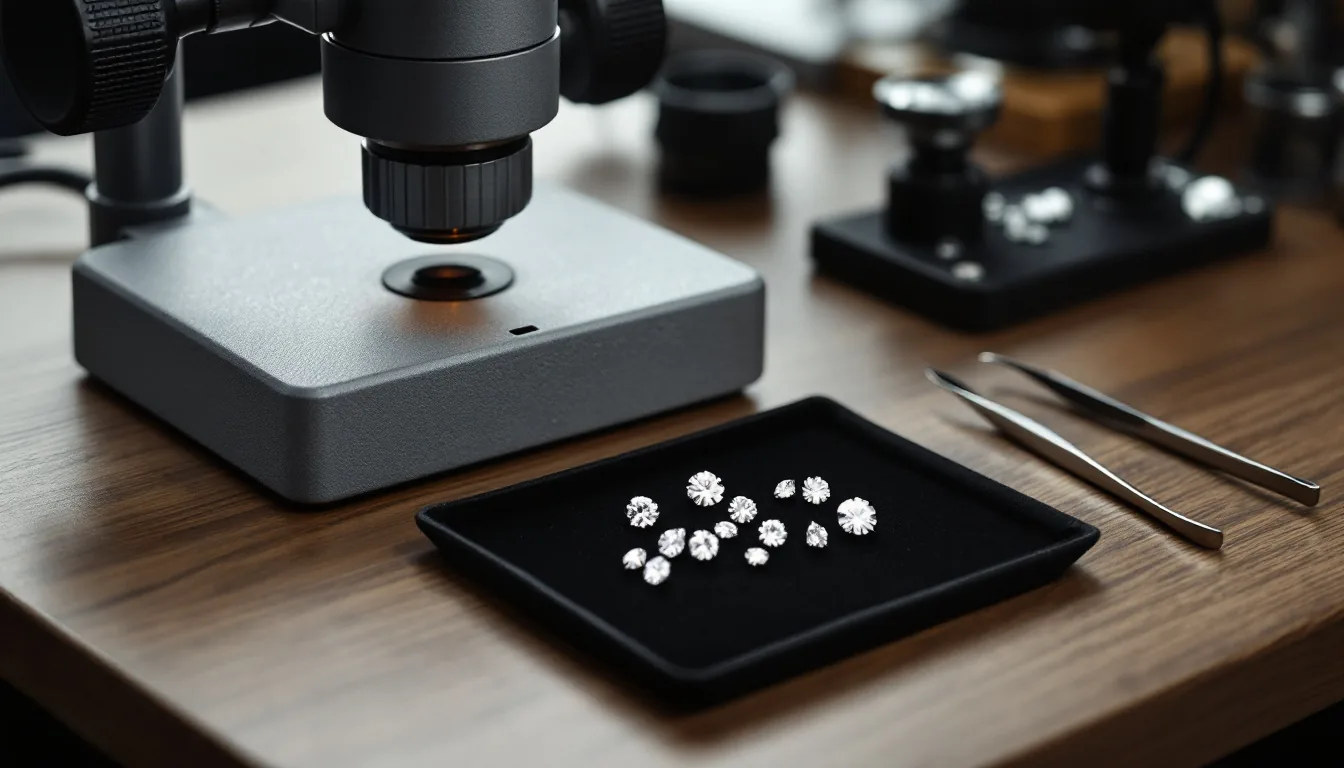
Every GIA clarity grade is based on what a trained grader sees at 10x magnification, the standard of a jeweler’s loupe. A feature visible only at higher power on a microscope does not lower the grade, which is why two people looking at the same stone under different equipment can disagree about how “clean” it is.
GIA weighs five factors for each characteristic:
- Size. Larger inclusions have more impact.
- Number. Several small features can matter more than one.
- Location. Features under or near the table are easier to see than those near the girdle, so they count for more.
- Relief. How much the feature contrasts with the surrounding diamond. A dark crystal has more relief than a colorless one.
- Nature. The type of feature, and whether it could affect durability, such as a feather that reaches the surface.
A GIA report’s plot maps where the main features sit. Matching the plot to the stone is a practical way to confirm a report belongs to the diamond in hand.
Eye-clean diamonds
“Eye-clean” is a trade term for a diamond whose inclusions cannot be seen with the unaided eye. GIA does not use it as a grade. In most cases a VS stone will be eye-clean, which is why GIA notes VS and VVS diamonds are hard to tell apart without magnification.
SI stones are where buyers should look carefully. Some SI1 and SI2 diamonds are eye-clean face up, while others show a feather or crystal under the table. Because eye-clean is a judgment about a specific stone, it should be checked in person, at normal viewing distance and under ordinary light, before any SI diamond is quoted as one.
How shape changes what you see
Cut style affects how visible a given inclusion will be. GIA notes that inclusions are typically easier to see in an emerald cut than in a round brilliant. Step cuts such as the emerald and asscher have long, open facets that act like windows into the stone. Brilliant cuts such as the round, oval and cushion break light into many small flashes that help hide small features.
For a buyer, that means a clarity grade that looks fine in a round may be visible in an emerald cut of the same grade. A buyer set on a step cut may want a higher clarity grade than one choosing a brilliant cut. For the main fancy shapes and how they are faceted, see Specialty Diamond Cuts.
Setting also plays a part. Prongs can cover a feature near the girdle, while a bezel or halo hides little at the center. A jeweler choosing a stone for a particular mounting can use the report plot to see where the features fall.
Buying notes
- Price follows rarity. GIA describes flawless diamonds as exceptionally rare, and prices rise steeply toward the top of the scale even where the difference cannot be seen.
- Check durability, not just looks. A large feather breaking the surface, especially near a prong or the girdle, deserves a closer look even in a mid-range grade.
- Ask about treatment. Laser drilling and fracture filling change how a diamond should be described and cared for.
- Read the report, not the ad. A report from an independent laboratory gives the grade and plot. How diamonds move from mine to counter is covered in The Diamond Pipeline.
- Balance clarity against color. Clarity is one of four Cs; the Diamond Color Scale explains the other grade most buyers trade off against it.
Lab-grown stones
Clarity grades for laboratory-grown diamonds now depend on the lab. Since October 1, 2025, GIA no longer applies its natural-diamond clarity and color grades to lab-grown stones. It places them in “Premium” or “Standard” categories instead, with clarity of VVS or better for Premium and VS for Standard. The differences between the two products are covered in Lab-Grown vs Natural Diamonds.
Common questions
Is VS2 or SI1 better value? VS2 is the higher grade, and GIA notes VS stones are almost always eye-clean. Many SI1 stones are too, but each one needs checking, so an eye-clean SI1 can be the better buy when budget matters.
Can a jeweler improve a diamond’s clarity? Repolishing can remove some blemishes. Laser drilling and fracture filling can make inclusions less visible, but both are treatments that should be disclosed.
Do inclusions make a diamond weaker? Most do not. GIA says I-grade inclusions may affect durability, and a large surface-reaching feather can be a weak point at any grade.