How Lab-Grown Diamonds Are Detected
The growth features, spectroscopy and imaging that separate HPHT and CVD lab-grown diamonds from natural ones, plus inscriptions, reports and FTC terms.
Lab-grown diamonds are detected by the traces their growth process leaves inside the crystal, not by hardness or thermal conductivity, which match natural diamond. HPHT-grown stones show cube-and-octahedron growth sectors and sometimes metallic inclusions; CVD-grown stones show layered growth striations and characteristic strain. Labs confirm these features with spectroscopy and ultraviolet imaging, while faster screening devices sort stones in the trade and pass any doubtful ones to a laboratory.
Two ways to grow a diamond
Almost all gem-quality laboratory-grown diamond comes from one of two processes, and each leaves its own fingerprint.
HPHT (high pressure, high temperature) relies on extreme pressure and heat. According to GIA, the growth chamber reaches about 1,300 to 1,600 °C at pressures above 870,000 pounds per square inch. Carbon dissolves in molten metal, typically iron, nickel or cobalt, and crystallizes onto a small diamond seed over several days to weeks.
CVD (chemical vapor deposition) builds diamond from a gas. A microwave beam breaks down a carbon-bearing gas such as methane in a vacuum chamber at about 900 to 1,200 °C, and carbon atoms settle layer by layer onto flat diamond seed plates. A growth run takes about three or four weeks and produces flat, tabular crystals.
Many CVD stones are treated after growth. GIA notes that most colorless CVD diamonds on the market were probably brown crystals decolorized by HPHT annealing, and a 2016 Gems & Gemology review found that about 70 percent of the near-colorless CVD samples studied had been annealed. Treatment changes some of the evidence, which is one reason identification relies on several tests rather than one.
Tell-tale features by growth method
Natural diamonds typically grow as octahedra. HPHT crystals develop cube faces as well as octahedral ones, and CVD crystals grow upward in layers. Those differences show up in a predictable set of features.
| Feature | Natural | HPHT-grown | CVD-grown |
|---|---|---|---|
| Growth pattern | Octahedral; type IIa stones show mosaic dislocation networks | Cuboctahedral (cross-shaped) growth sectors | Parallel striations from layered growth |
| Typical inclusions | Mineral crystals, fractures | Metallic flux (iron, nickel, cobalt) | Dark non-diamond carbon specks; no metal |
| Color distribution | Varies | Uneven, geometric zoning | Generally even |
| Strain (crossed polarizers) | Cross-hatched, mottled or banded patterns | Very weak or none | Banded or columnar, higher-order interference colors |
What a microscope can show
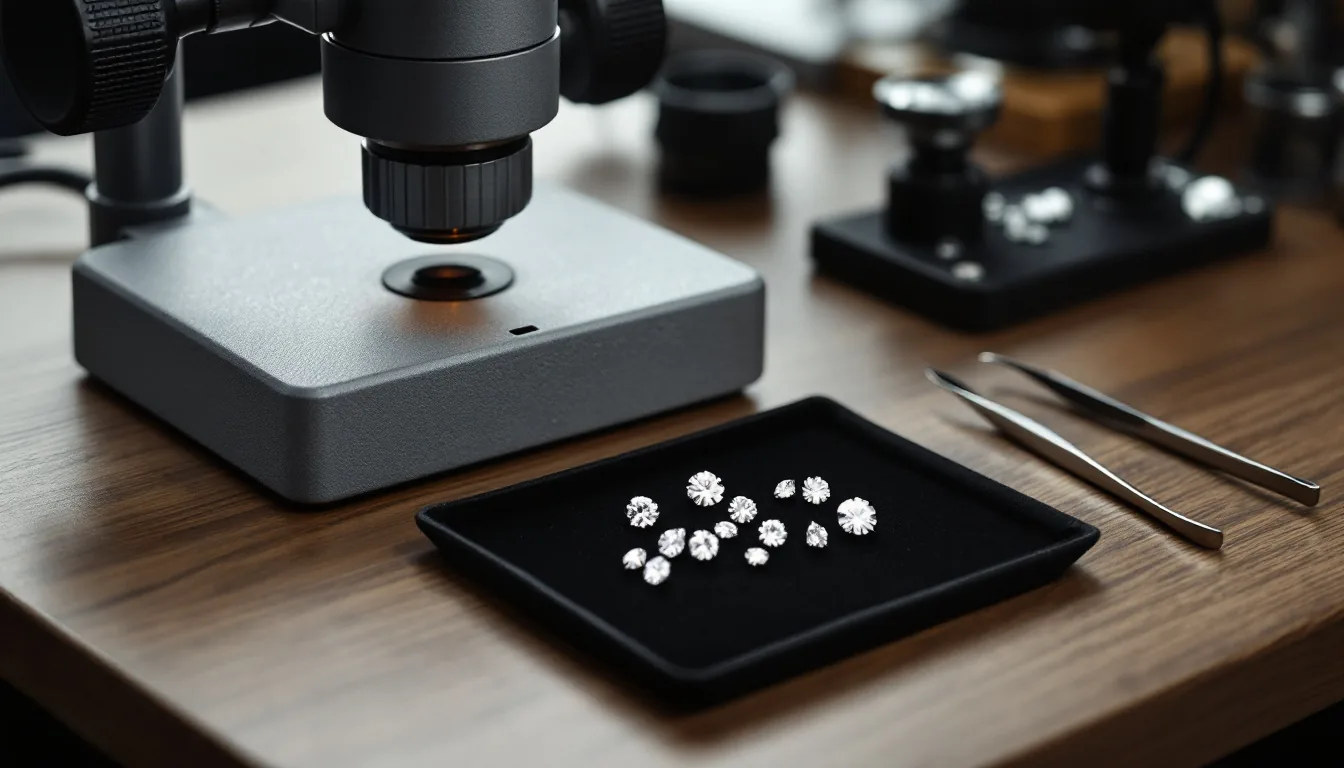
A skilled gemologist can sometimes spot a lab-grown stone with standard tools. Metallic inclusions in HPHT diamonds look black in transmitted light and metallic in reflected light, and GIA researchers studying large Russian HPHT stones found that well-included samples were attracted to a strong magnet. Between crossed polarizers, HPHT stones show almost no strain, while CVD stones often show banding along the growth direction.
These are indications, not proof. Clean stones may show nothing at all, and GIA has documented CVD diamonds with very few diagnostic features. Microscope observations are a reason to test further, not a basis for a report.
Spectroscopy: reading the defects
Spectroscopy identifies the atomic-scale defects that growth and treatment create.
- Infrared (FTIR) shows how much nitrogen is present and in what form, which sets the diamond’s type. Since roughly 99 percent of natural D-to-Z diamonds are type Ia, a type IIa or IIb result flags a stone for closer study.
- Ultraviolet-visible absorption looks for the 415 nm N3 line common in natural diamond and absent in lab-grown material.
- Photoluminescence (PL), usually measured with the stone cooled in liquid nitrogen, detects trace defects. The silicon-vacancy doublet near 737 nm is, in the words of the 2016 GIA review, “a strong indicator of CVD growth” and is “seen very rarely in natural diamonds.” Nitrogen-vacancy centers, with lines at 575 and 637 nm, cause the orange luminescence typical of as-grown CVD stones. A doublet near 596 and 597 nm marks as-grown CVD material, so its absence in a CVD stone points to HPHT annealing.
Imaging growth structure
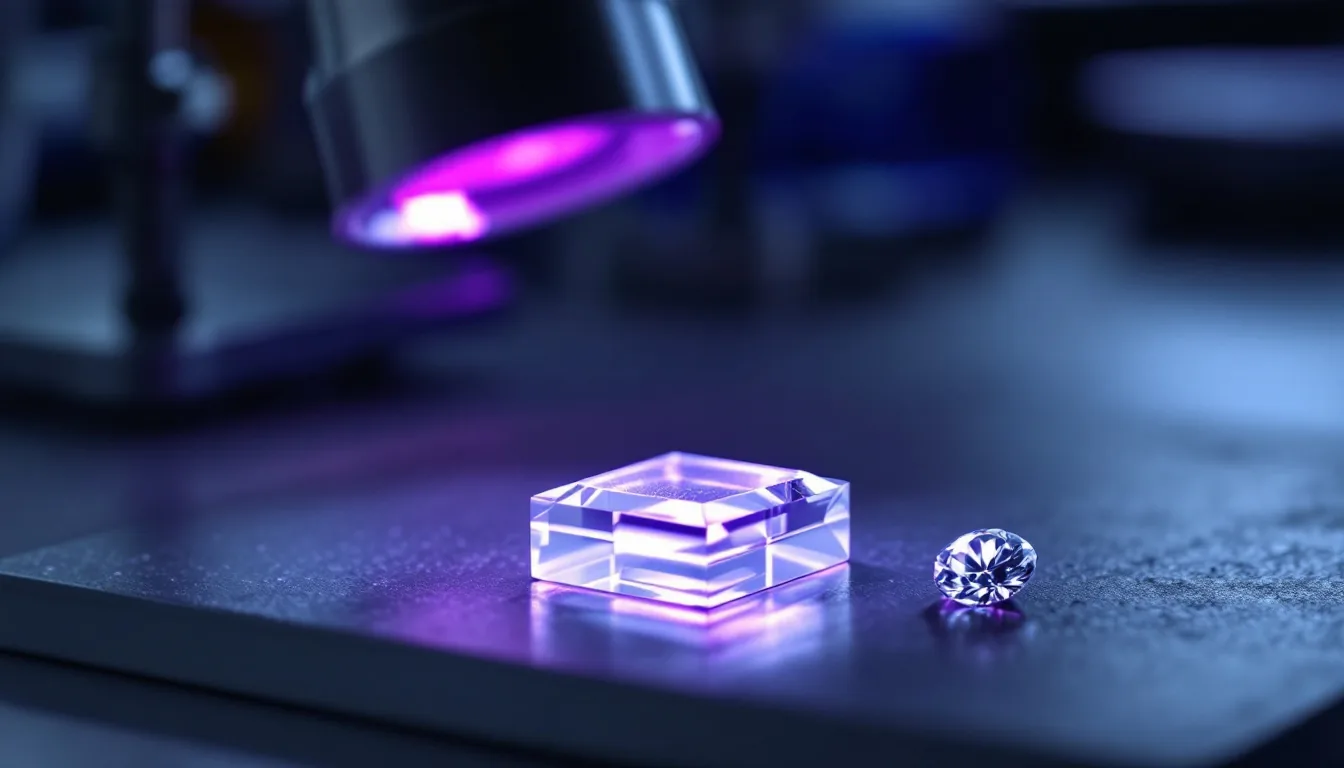
Deep-ultraviolet luminescence imaging, commonly done with De Beers’ DiamondView, makes growth structure visible. HPHT stones show blocky cuboctahedral sectors, often followed by blue phosphorescence. CVD stones show fine striations, especially through the pavilion facets, in colors that range from orange-red to blue and greenish blue. Natural type IIa stones, the ones most easily confused with lab-grown material, show networks of dislocations that lab-grown diamonds lack. Long-lasting phosphorescence is rarely seen in natural diamonds.
Screening devices versus laboratory reports
Screening devices make the first cut in the trade. Instruments such as De Beers’ DiamondSure and SYNTHdetect, and the GIA iD100, give a “pass” for stones they can confirm as natural and “refer” everything else. A referral is not a finding that a stone is lab-grown; it means the device cannot confirm natural origin.
A laboratory report rests on a fuller set of tests. The 2016 GIA review concluded that reliable identification requires “a full complement of gemological, imaging, and spectroscopy instrumentation.” Anyone selling stones of uncertain origin, especially melee, mixed parcels or stones without documents, should treat a referral as a reason to submit the stone to a laboratory.
Inscriptions and report wording
Labs mark what they identify. GIA began issuing reports for man-made diamonds in January 2007. On July 1, 2019, its Synthetic Diamond Grading Report became the GIA Laboratory-Grown Diamond Report, and the word “synthetic” was dropped from the identification line. National Jeweler reported that the change followed the FTC’s removal of “synthetic” from its recommended terms. The 2019 report also stated that a man-made diamond may have undergone post-growth treatment to change its color.
GIA changed course again on October 1, 2025. In June that year it said more than 95 percent of lab-grown diamonds entering the market fall into a very narrow range of color and clarity, and it stopped describing them with the natural-diamond color and clarity scales. The replacement GIA Laboratory-Grown Diamond Quality Assessment classifies stones of 0.15 carat and up as “Premium” or “Standard,” or gives no designation. Each assessed stone is laser-inscribed with “Laboratory-Grown” and its assessment number on the girdle.
An inscription is useful but not proof. In 2017, GIA’s Carlsbad lab examined a 1.76-carat HPHT-grown diamond inscribed with the number of a GIA report issued for a natural diamond; DiamondView imaging and infrared spectroscopy exposed it, and the inscription’s typeface did not match GIA’s. In a 2025 case at GIA’s Dubai lab, four stones carried counterfeit GIA inscriptions: two were CVD-grown and two were HPHT-processed natural diamonds. Inscriptions can also be polished off. When a stone and its paperwork do not agree, the lab, not the inscription, has the final word.
What the FTC expects
The FTC’s Jewelry Guides, revised in July 2018, set out the terms US sellers should use. In plain English:
- A lab-grown diamond must be described with a qualifier that appears immediately before the word “diamond” and is just as prominent: “laboratory-grown,” “laboratory-created,” “[manufacturer name]-created,” or a phrase of similar meaning.
- “Cultured” is allowed only alongside a clear qualifier of that kind. “Faux” is not an adequate disclosure.
- Words such as “real,” “genuine” and “natural” must not be used for a manufactured product.
- Diamond simulants such as cubic zirconia must be called “imitation” or “simulated” if a gem name is used.
In April 2019, FTC staff sent warning letters to eight jewelry marketers. The letters flagged ads that might imply a simulant was lab-grown or mined, or that a lab-grown stone was mined, and disclosures placed away from individual product descriptions. They also cautioned against unqualified claims such as “eco-friendly” and “sustainable.” This summary is not legal advice; sellers should read the Guides themselves.
Questions jewelers ask
Will a standard diamond tester catch a lab-grown diamond?
No. Thermal and electrical “diamond testers” are designed to separate diamond from simulants. A lab-grown diamond is diamond, so it reads as diamond. Separating lab-grown from natural requires a dedicated screening device or a laboratory.
Can a seller rely on a report number on the girdle?
Only after checking that the stone matches the report. GIA’s cases show that numbers can be copied onto other stones. Comparing measurements, weight and grades against the report helps, and a lab can confirm the match.
Further reading
- GIA: HPHT and CVD Diamond Growth Processes
- Gems & Gemology (Fall 2016): Observations on CVD-Grown Synthetic Diamonds: A Review
- Gems & Gemology (Fall 2015): Large Colorless HPHT-Grown Synthetic Gem Diamonds from New Diamond Technology, Russia
- Gems & Gemology (Fall 2017 Lab Notes): Synthetic Diamond Fraudulently Inscribed to Match Natural Diamond Report
- GIA: Updated Laboratory-Grown Diamond Services to Launch October 1 (August 2025)
- FTC: Warning Letters to Companies Regarding Diamond Ad Disclosures (April 2019)