Specialty Diamond Cuts: A Guide Beyond the Round Brilliant
Princess, cushion, Asscher, radiant, emerald, oval, pear, marquise and antique cuts explained, plus how fancy shapes are graded and what to check before buying.
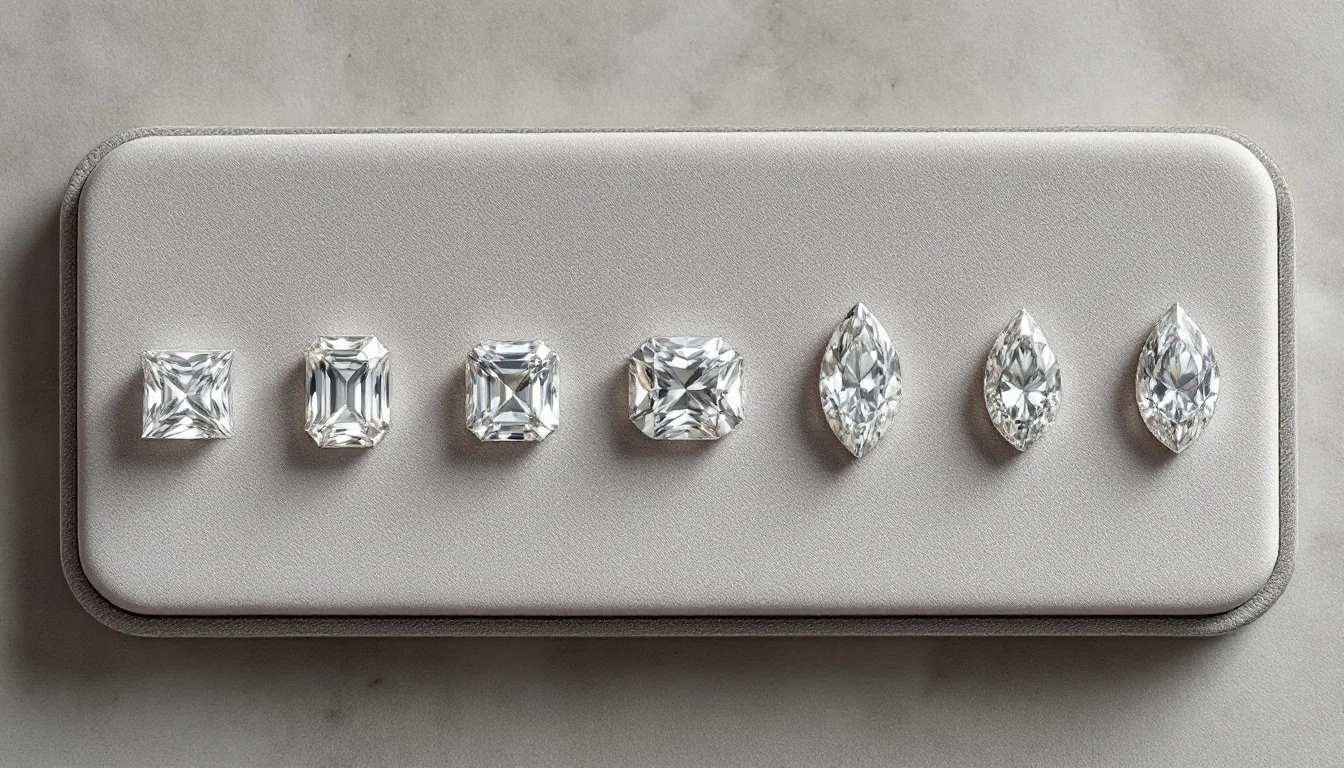
Any diamond that is not a standard round brilliant is called a fancy shape, and each shape handles light, hides inclusions and wears differently. The main families are brilliant-style shapes (princess, oval, pear, marquise, heart, cushion), step cuts (emerald and Asscher), mixed cuts such as the radiant, and antique styles such as the old mine, old European and rose cut. GIA gives an overall cut grade only to round brilliants, so judging a fancy shape relies on its polish and symmetry grades, its proportions and a careful look at the stone itself.
Three ways to facet a diamond
Every cut uses one of three basic facet arrangements, and knowing which one you are looking at predicts most of its behavior.
- Brilliant-style cuts use triangular and kite-shaped facets that break light into many small flashes. They hide inclusions and body color relatively well.
- Step cuts use long, rectangular facets parallel to the girdle, like a staircase. They produce broad flashes rather than sparkle, often described as a “hall of mirrors,” and show inclusions and color more readily.
- Mixed cuts combine the two, usually step facets on the crown and brilliant facets on the pavilion.
The modern fancy shapes
| Shape | Faceting style | Strengths | Watch for |
|---|---|---|---|
| Princess | Square modified brilliant | Bright; pointed corners help hide inclusions | Sharp corners chip without protective prongs; deep pavilion can make it look smaller |
| Cushion | Brilliant or modified brilliant | Soft outline, distinctive sparkle pattern | Uneven curves on sides or corners; thin girdle areas |
| Emerald | Step cut | Clean, architectural look | Shows inclusions and color easily |
| Asscher | Square step cut | Art Deco character | Shows inclusions and body color readily |
| Radiant | Mixed (step crown, brilliant pavilion) | Brilliance in a cut-corner rectangle or square; forgiving of inclusions | Proportions vary widely; uneven corners |
| Oval | Brilliant | Looks larger per carat than a round | Bow-tie shadow |
| Pear | Brilliant | Sparkle with an elongating outline | Bow-tie shadow; exposed point |
| Marquise | Brilliant | Looks largest for its weight | Two exposed points; asymmetry is obvious |
| Heart | Brilliant | Distinctive outline | Needs strong symmetry and enough size to read as a heart |
Princess
The princess is a square modified brilliant, the most common square shape in modern engagement rings. Its four pointed corners are its weak spot: GIA advises protective settings, such as prongs that cover each corner, to prevent chipping. Because princess cuts are often cut with deep pavilions, a princess can face up slightly smaller than other square shapes of the same weight.
Cushion
The cushion descends from the old mine cut used from the early 18th century to the late 19th century. Modern cushion brilliants are square to rectangular with curved sides and rounded or pointed corners. Traditional versions have four or eight main pavilion facets; a “modified cushion brilliant” adds extra facets, which changes the sparkle from larger flashes to a finer, busier pattern. GIA’s checklist for cushions is mostly about symmetry: the sides and corners should mirror each other so the outline does not look lopsided.
Emerald and Asscher
Both are step cuts. The emerald cut is a rectangle with cut corners; the Asscher is a square version with a deeper, more layered look. GIA dates the Asscher to the early 1900s and notes its popularity during the Art Deco era. The Royal Asscher company traces it to a 1902 patent by Joseph Asscher of Amsterdam.
Step cuts are honest about clarity. Their large, open facets act like windows, so inclusions and body color that a brilliant might hide are easier to see. GIA suggests buyers of emerald cuts look for VS2 clarity and G color or better.
Radiant
According to GIA, the radiant cut was patented in the late 1970s by Henry Grossbard, and other cutters replicated it after the patent lapsed. It has an eight-sided, cut-corner outline like an emerald cut, but with brilliant faceting on the pavilion, so it sparkles like a brilliant and masks inclusions better than a step cut. The cropped corners also make it less prone to chipping than a princess. GIA’s buying advice: look for a centered culet, parallel sides and corners of even width.
Oval, pear, marquise and heart
These are elongated or outlined brilliants. Ovals and marquises spread their weight over a larger face-up area, so they look bigger for their carat weight. GIA reports typical oval length-to-width ratios of about 1.3:1 to 1.4:1. Pears and marquises have points that should be protected by a prong. With hearts and marquises, symmetry is everything: uneven lobes, a crooked cleft or mismatched points are obvious at a glance. GIA suggests hearts of 0.50 carat or larger so the shape reads clearly once set.
The bow-tie effect
Many ovals, pears and marquises show a bow-tie: a dark, bow-tie-shaped shadow running across the width of the stone through its center. Almost every elongated brilliant shows some of it. The question is how strong it is, and that depends on how the stone was cut.
A grading report does not measure the bow-tie, so the only way to judge it is to look at the stone face-up, ideally as it rocks gently under normal lighting. A faint bow-tie that shifts as the stone moves is normal; a broad, black band that stays put is a cutting weakness and should lower the price.
Antique cuts
Older cutting styles were cut by hand to save weight from the rough, not to follow modern light-performance formulas. They have larger facets, higher crowns and smaller tables than modern cuts, which gives broad flashes of fire and a softer brilliance.
- Rose cut. One of the earliest styles, dating to the 16th century and common through the Georgian and Victorian eras. It has a flat base with no pavilion and a domed top of triangular facets rising to a point.
- Old mine cut. A squarish cushion outline with a high crown, small table, short lower half facets and a large, visible culet, typically with 58 facets. GIA notes the name probably arose in the late 1800s, when African production began to eclipse the “old mines” of Brazil and India.
- Old European cut. Round, with a high crown, small table and a smaller visible culet than the old mine cut. It was the dominant round cut from the late 19th century into the early 20th century.
- Transitional cut. Bridges old European and modern proportions; it appeared in the late Victorian period and remained common into the mid-20th century.
A GIA report on an antique-cut diamond records its cutting style but does not determine its age or when it was cut. New stones are also cut in antique styles.
A note on terminology
The FTC’s Jewelry Guides allow the unqualified word “diamond” only for a stone with at least 17 polished facets when symmetrically fashioned. A stone with fewer facets can still be called a diamond if the facet count is disclosed or a shape name is used, with “rose diamond” given as the example.
How fancy shapes are graded
GIA spent 15 years developing its cut grade, using computer modeling and more than 70,000 observations of real diamonds. The resulting Excellent-to-Poor cut grade applies only to standard round brilliants in the D-to-Z color range. Fancy shapes receive color and clarity grades and are evaluated for polish and symmetry, but there is no overall GIA cut grade for them.
In practice, that leaves the buyer with four tools:
- Polish and symmetry grades on the report, which reflect craftsmanship.
- Measurements, which give the length-to-width ratio and depth.
- The proportions diagram, where available, which helps spot very deep stones that face up small.
- The stone itself, for bow-tie, outline and overall brightness.
Buying checklist for fancy shapes
- Decide on the outline first, then compare length-to-width ratios within that shape; small changes alter the look noticeably.
- Check that the outline is symmetrical: matching sides, even corners, a centered point or culet.
- Judge the bow-tie in person or on unedited video.
- Raise clarity and color expectations for step cuts, which show more.
- Protect points and corners with the setting, and check that girdles are not knife-thin at those spots.
- Compare face-up size, not just carat weight; a deep stone carries weight where it cannot be seen.
- Get a laboratory report and read the polish and symmetry grades, since no cut grade will summarize them for you.
Further reading
- GIA 4Cs: Diamond Cut
- GIA 4Cs: Guide to Diamond Shapes for Engagement Rings
- GIA 4Cs: Antique Diamond Cuts: History, Craftsmanship and Enduring Appeal
- GIA 4Cs: Old Mine Cut Diamond: Timeless Romance
- GIA 4Cs: How to Select a Radiant Cut Diamond
- FTC Jewelry Guides, 16 CFR 23.12: Definition and misuse of the word diamond