French Pavé Setting: Technique and Variations
What French pavé means compared with U-cut and standard pavé, how the seats and prongs are cut, where micro pavé and the microscope fit in, and quality checks.
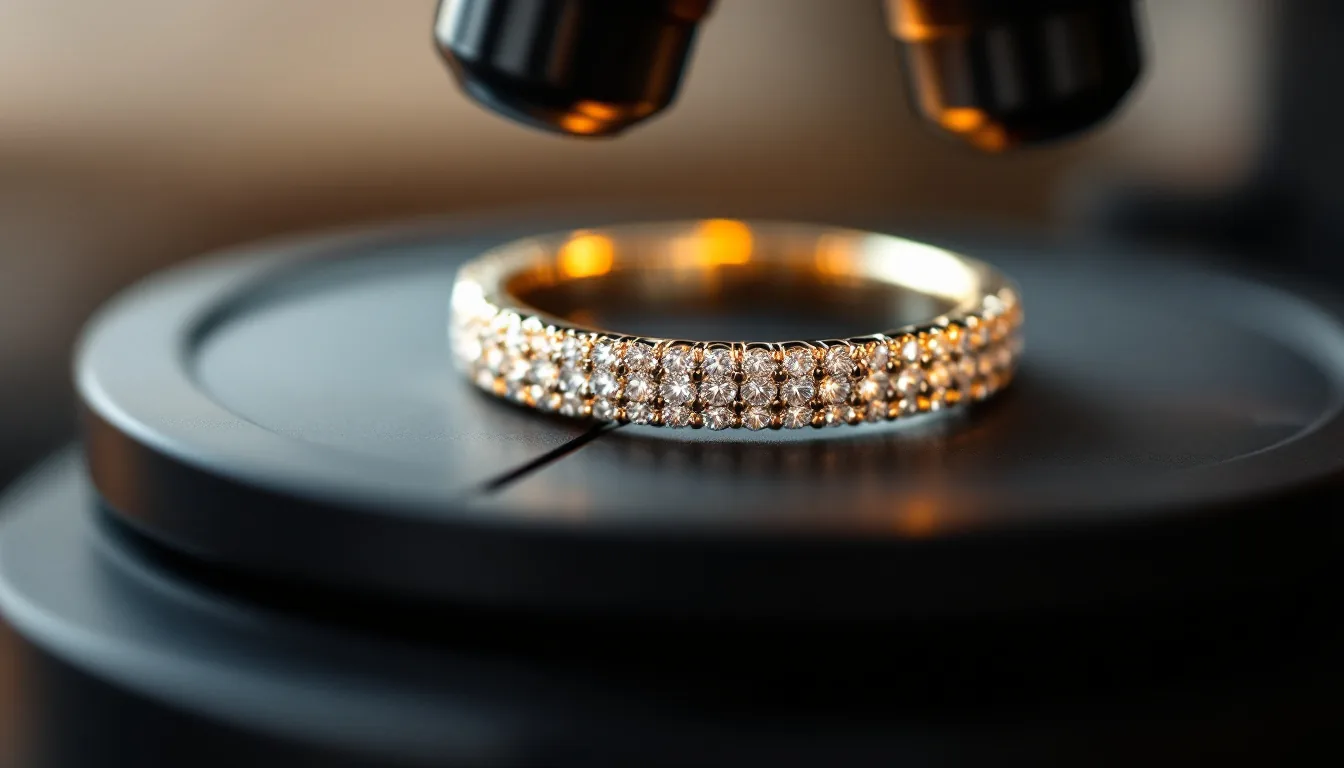
French pavé is a style of pavé in which the metal between and beneath closely set stones is cut away in V shapes, so each stone is held by small, bright-cut prongs and shows more of its sides than in standard bead-set pavé. The result is less visible metal and more light reaching the stones, at the cost of extra bench time and less metal protecting the girdles. The name is used loosely in the trade, so it pays to describe the profile and the prongs rather than rely on the label.
What the term covers
GIA defines pavé as a style of bead setting in which many small stones are set close together, and elsewhere as stones set in three or more rows with hand-raised beads. “French” narrows that in different ways depending on who is speaking:
- Profile definition. Manufacturer Victor Canera describes French pavé as using V-shaped cuts of metal between the stones, giving an angular profile in which the bright-cut facets read as a “w”. U-cut pavé is the same idea with rounded, U-shaped grooves.
- Wedge definition. Writing for Stuller, Brett Northcutt describes “French cut” setting as securing the stones by wedging metal over them rather than with conventional prongs. A 45° cut splits the metal between stones, and the polished bright cuts produce what he calls a butterfly effect.
- Setter’s definition. New York workshop Leon Megé argues that “French” and “U-cut” are informal names for what setters call cut-down pavé: small arches and vertical slits on both sides of each seat, with four beads per stone. It treats fishtail and V-cut pavé as separate, more engraved styles.
None of these is a formal standard. When ordering or quoting work, specify the profile (V or U), the number of prongs per stone and the stone sizes. “French cut” is also the name of a historic gem-cutting style, which is a separate subject.
How the styles compare
| Style | How stones are held | Side profile | Trade-off |
|---|---|---|---|
| Standard bead-set pavé | Hand-raised beads, often shared between stones | Solid metal wall | Most metal; simplest and robust |
| Bright-cut pavé | Beads, with polished bevel walls framing the rows | Solid wall | Victor Canera rates it the most protective of the girdles |
| French (V-cut) pavé | Small prongs split from the metal between stones | V-shaped openings under each stone | More light, less metal; labor-intensive |
| U-cut (scalloped) pavé | Prongs or beads between stones | Rounded arches under each stone | Deeper cuts expose more of the stone but leave less metal |
| Fishtail pavé | Prongs, with faceted mirrors cut beneath the stones | Faceted, forked pattern | Leon Megé uses it for stones of 1.1 mm or less |
| Micro pavé | Very small stones and beads, set under a microscope | Any of the above | Smaller beads look finer but wear sooner |
Seat geometry
French pavé starts as ordinary pavé layout. The seats have to be right before any decorative cutting begins, because every prong is shared between neighbors.
- Spacing. Stuller sets dividers to the stone’s width plus the clearance between stones and lays the seats out on a grid. In a single-row method published in MJSA Journal, Joel McFadden spaces stones so a sheet of paper would just slide between the girdles.
- Metal width. McFadden leaves a strip at least 0.5 mm wider than the stones on each side.
- Hole sizes. McFadden drills a 0.5 mm pilot, opens the top of each hole to about 75% of the stone’s diameter with a cone bur, sets the depth with a setting bur at about 90%, and opens the seats to full size with a heart (hart) bur only after the prong cuts are made.
- Depth. Stuller cuts seats until the stone’s table is flush with the top surface, cutting in small increments and rotating the bur slightly to enlarge a tight seat. McFadden seats single-row stones with the girdle level with the metal.
- Consistency. All tables must sit at the same height, centered on the layout points. With shared prongs, a stone that sits low or high leaves its neighbors’ prongs short of the girdle.
The V or U cuts in the side of the piece are positioned under each stone, so every opening is centered on a seat and every prong keeps a solid base between openings.
Cutting the prongs: a typical sequence
This sequence follows McFadden’s single-row method, with notes on the French wedge cut.
- Lay out and drill. Mark the positions, make a small divot with a sub-millimeter ball bur, and drill pilot holes through.
- Open and set depth. Open the tops to about 75% and establish seat depth with the setting bur.
- Bright-cut from hole to hole. With an onglette or knife graver, cut from the edge of each hole, to a depth just below where the girdle will sit. Cut a center relief line from hole to hole with a round-bottom graver.
- Knock out the prongs. Set the round-bottom graver at 90 degrees into the bright cut and make one short cut toward the center of the hole. This divides the metal into prongs; recut where they come out uneven.
- Open the seats to 100%. Use a heart bur the size of the stones.
- Set the stones. Use the graver to nudge each prong toward the space between two stones, so every prong except those at the ends holds two stones.
- Round the tips. Finish the prong tops with a beading tool.
Stuller’s general pavé method splits each square of metal between seats corner to corner with a knife-edge graver, raises beads with a round graver, rounds them with a beading tool, and removes flashing with a knife-edge graver. Northcutt’s French cut adds a wedge: a 45° graver shaped on a power hone splits each notched prong and tightens it over the girdle in one move, and a pre-cut 75° graver bright-cuts the prongs. He polishes his gravers on a ceramic wheel at 1200 grit, with diamond spray, because the finish of the tool becomes the finish of the cut.
For the underlying graver work, see Bead and Bright-Cut Setting Explained.
The microscope and micro pavé
Pavé of every kind is built from small stones, typically melee. GIA defines melee as diamonds and gemstones under 1/5 carat. Victor Canera notes that micro pavé was historically reserved for stones of about half a point (0.005 ct) or smaller, set under a microscope. The firm also stresses that the melee must be very consistent in size, to within 0.02 mm, for the work to look even.
Leon Megé reserves the term “micro pavé” for multiple interlocking rows of small stones that follow the surface of the piece; in its view, a single row of small stones is not micro pavé. Advanced pavé courses, such as the micro-setting class at the New Approach School for Jewelers, expect students to arrive already able to work under a stereo microscope.
Practical consequences for the bench:
- Use calibrated stones. With shared prongs, size variation shows immediately as gaps or tilted tables.
- Scale the tools down: small drills, small burs and small beading tools.
- Set up the microscope for a working distance that leaves room for the graver, with lighting that does not glare off polished metal.
Quality checks
Inspect under magnification from the top, from both sides and from each end:
- Tables level, at the same height and in straight lines
- No stone moves when pressed gently with a brass pusher
- Prongs even in size, rounded on top and in contact with each girdle they hold
- Side cuts symmetrical, centered under the stones and of equal depth
- Prong bases not undercut thin by the side cuts
- Bright cuts mirror-bright, with no chatter marks or flashing left behind
- No chipped girdles and no graver marks on the stones
Questions
Is French pavé less durable than standard pavé?
Generally there is less metal guarding each stone. Leon Megé puts the trade-off plainly: smaller beads give better-looking pavé but are more vulnerable to wear and tear. Northcutt, by contrast, argues that properly wedged metal holds stones more securely than typical prongs. Either way, owners should have small-prong pavé checked at regular cleanings.
Is French pavé the same as micro pavé?
No. “French” describes how the metal is cut; “micro” describes the size of the stones and the scale of the work. A piece can be both, either or neither.