Tanzanite: Where It Comes From and How to Buy It
Tanzanite is mined commercially only in Tanzania's Merelani Hills. How it is heated, graded and traded, and what the 2002 Tucson protocols changed.
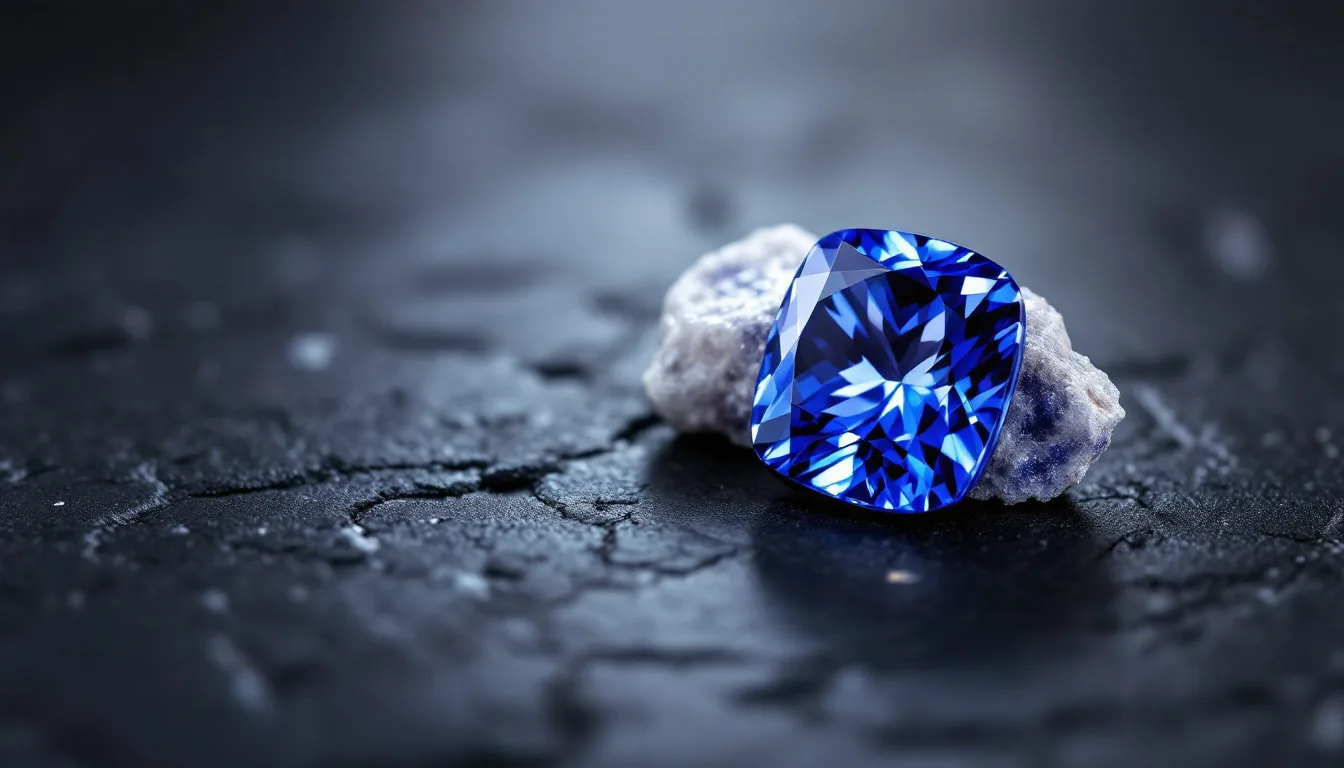
Tanzanite comes from one place: a small mining district in the Merelani (also spelled Mirerani) Hills of northern Tanzania, near Mount Kilimanjaro. Almost all of it is heat treated to bring out its blue and violet color, and buyers judge it mainly on the depth and balance of that color. Because the supply has a single source, the trade has also been unusually sensitive to questions about where stones come from and who profits from them.
One deposit, one country
Tanzanite is the trade name for blue to violet zoisite, a calcium aluminum silicate that GIA gives as Ca₂Al₃(SiO₄)₃(OH). Its color comes from trace vanadium. A 2012 peer-reviewed review of Merelani zoisite by Bocchio and colleagues describes the deposit as the only source of tanzanite in the world, and GIA calls the Merelani Hills its only commercial mining location.
According to GIA’s history of the gem, the find dates to 1967, when a Maasai tribesman alerted a prospector named Manuel d’Souza, who registered four claims. Within a short time some 90 more claims had been staked in the same area of roughly 20 square miles. The district is now administered as mining blocks labeled A through D. In the mid-2000s, Colored Stone magazine reported (in an article republished by Ganoksin) that Blocks B and D were worked by independent small-scale miners while Block C was mined by the company TanzaniteOne.
A single-source gem behaves differently in the market. A flood, a policy change or a security crackdown in one district affects global supply directly, and there is no second origin to absorb the shock.
| Property | Tanzanite (per GIA) |
|---|---|
| Mineral | Zoisite |
| Refractive index | 1.691 to 1.700 |
| Birefringence | 0.008 to 0.013 |
| Specific gravity | 3.35 |
| Mohs hardness | 6 to 7 |
| Typical color | Violet blue to bluish violet to violet purple |
Heat treatment is the norm
GIA notes that untreated tanzanite is typically brownish, and most tanzanite on the market has been heated to remove or reduce the yellow-green or brownish pleochroic color, which leaves the blue and violet. The Bocchio study tested this directly: brown, yellow and other non-blue zoisite became permanently blue at about 500°C, and its pleochroism changed from three colors to two. Samples that were already blue showed no change.
The practical consequence is that a heated stone and an unheated blue stone can look identical, and labs usually cannot tell them apart. GIA states that gem labs often cannot determine whether an individual tanzanite has been heated, and that heating has little effect on price. The Laboratory Manual Harmonisation Committee (a group of major labs including GIA, SSEF and Gübelin) lists zoisite (tanzanite) in Information Sheet #8 among gems whose treatment is “typically not determinable,” and its standard report wording says such stones are commonly heated.
Disclosure
Under the US FTC Jewelry Guides (16 CFR 23.24), a seller should disclose a gemstone treatment when the treatment is not permanent, when it creates special care requirements, or when it significantly affects the stone’s value. Tanzanite’s heat treatment is permanent and adds no special care, but the simplest and safest course is to tell the customer the stone has almost certainly been heated, in writing. This is a plain-English summary, not legal advice.
Trichroism and why orientation matters
Unheated tanzanite is strongly trichroic, showing different colors along different crystal directions. GIA cites a 1969 description in American Mineralogist of those colors as red-violet, deep blue and yellow green. Heating removes the yellow-green or brown direction, which is why finished stones show a play between blue and violet.
The cutter decides which of those colors faces up. GIA explains that orientations favoring violet-purple usually waste less rough, while violetish blue stones sell for more per carat, so every cut involves a trade-off between yield and price.
Lighting changes the impression as well. Cool, daylight-type fluorescent light emphasizes blue, and warm incandescent light brings out violet and purple. A stone that looks sapphire blue under cool light can look noticeably more purple under warm incandescent bulbs.
How tanzanite is graded
GIA assesses tanzanite on four quality factors, and color carries the most weight.
| Factor | What raises value | What lowers value |
|---|---|---|
| Color | Saturated, vivid violetish blue; GIA describes exceptional stones as intense violetish blue with red flashes | Pale, pastel or grayish color (more abundant and more affordable) |
| Size | GIA notes the finest, deepest colors usually appear in stones over 5 carats | Smaller stones tend to show less intense color |
| Clarity | Most faceted stones are eye-clean | Eye-visible inclusions or fractures, which also raise durability concerns |
| Cut | Orientation that shows the desired color face-up, with good brilliance | Shallow or windowed cuts made to save weight |
Color dominates. Two stones of the same size and clarity can differ greatly in price because one is a saturated blue and the other a light lavender.
Durability in jewelry
GIA’s care guidance puts tanzanite at 6 to 7 on the Mohs scale with fair to poor toughness and a cleavage direction, meaning a hard knock can split it. It can be worn in any type of jewelry with sensible precautions. Rings get the most abuse, so protective settings and occasional wear are worth recommending.
For cleaning, warm soapy water is safe. GIA says ultrasonic and steam cleaners should never be used, and that tanzanite should not be exposed to very high temperatures or sudden temperature changes. At the bench, that means removing the stone before any torch work on the mounting.
The 2001 terrorism reports and the Tucson protocols
In November 2001, The Wall Street Journal published a report, co-authored by Robert Block, alleging links between the tanzanite trade and the al Qaeda network. JCK reported that the story ran in the Journal’s November 16, 2001, edition, and that retailers including Tiffany & Co. and the shopping channel QVC suspended tanzanite sales afterward.
Trade groups pushed back. According to JCK, a joint statement from Jewelers of America, the American Gem Society, the American Gem Trade Association (AGTA), the manufacturers’ association MJSA and the Jewelers Vigilance Committee described the report as new information not previously known in the industry. The president of the International Colored Gemstone Association questioned the sourcing.
The industry’s formal response came at the AGTA GemFair in Tucson. JCK reported that the Tucson Tanzanite Protocols were agreed in a closed-door meeting on February 8, 2002, and announced the next day. They were endorsed by the Government of Tanzania, AGTA, the Tanzania Mineral Dealers Association, the Arusha Regional Miners Association, the Tanzania Chamber of Mines, Jewelers of America, the Jewelers Vigilance Committee, the American Gem Society, MJSA, the International Colored Gemstone Association and two Indian trade bodies. The main provisions were:
- A detailed analysis of the tanzanite market chain.
- Joint government and industry oversight of tanzanite from the mine to first export.
- A written warranty system certifying that stones came from legitimate sources.
- Inclusion of the tanzanite industry in Tanzania’s Export Processing Zones.
- A requirement that downstream traders accept only warranted tanzanite, and obtain warranties from their own suppliers.
At the same meeting, according to JCK, Mike O’Keefe of the US State Department’s Office of East African Affairs said the department had seen no evidence that al Qaeda or any other terrorist group was then using tanzanite sales to finance itself, while acknowledging a past case involving an al Qaeda operative. JCK noted that the US market accounted for an estimated 80 to 90 percent of the tanzanite trade at the time, which is why American retailers’ decisions mattered so much.
The Merelani wall
The security question resurfaced 15 years later. In September 2017, President John Magufuli directed Tanzania’s armed forces to build a wall around Blocks A to D to curb smuggling and illegal dealing, The Citizen reported. The chairman of the Tanzania Mineral Dealers Association told the paper that a wall had been recommended under the 2002 Tucson protocol.
National Service units built the 24.5-kilometer wall between November 2017 and January 2018, at a reported cost of Sh5.645 billion, and Magufuli formally commissioned it in April 2018, according to The Citizen.
Buying checklist
- Look in two lights. Check the stone in daylight-equivalent light and in warm light, and decide whether the blue-to-violet balance suits the customer.
- Assume heat. Price stones as heated, disclose it, and be wary of premiums for “unheated” claims that labs generally cannot confirm.
- Inspect edges. Look for chips at the girdle and facet junctions and for surface-reaching fractures.
- Match setting to use. Recommend protective mountings for rings worn daily.
- Use a lab for important stones. A report confirms the stone is zoisite and not a simulant; expect wording that it is commonly heated.
- Ask about provenance. The 2002 protocols built a chain of written warranties. Asking suppliers for comparable written source assurances remains reasonable practice.
- Hand over care instructions. Soapy water only, no ultrasonic or steam, and no exposure to heat.
Further reading
- GIA: Tanzanite Description
- GIA: Tanzanite Quality Factors
- Bocchio et al. (2012), Gem-quality zoisite from Merelani (Northeastern Tanzania): review and new data, Periodico di Mineralogia
- JCK: The Tucson Tanzanite Protocols (2002)
- The Citizen (Tanzania): JPM unveils Mirerani wall, offers 2,000 jobs
- FTC Jewelry Guides, 16 CFR 23.24: Disclosure of treatments to gemstones