Dyed and Irradiated Cultured Pearls: How to Identify Them
How dyed and irradiated cultured pearls are made, the signs at the counter, how labs separate them from natural-color black pearls, and what to disclose.
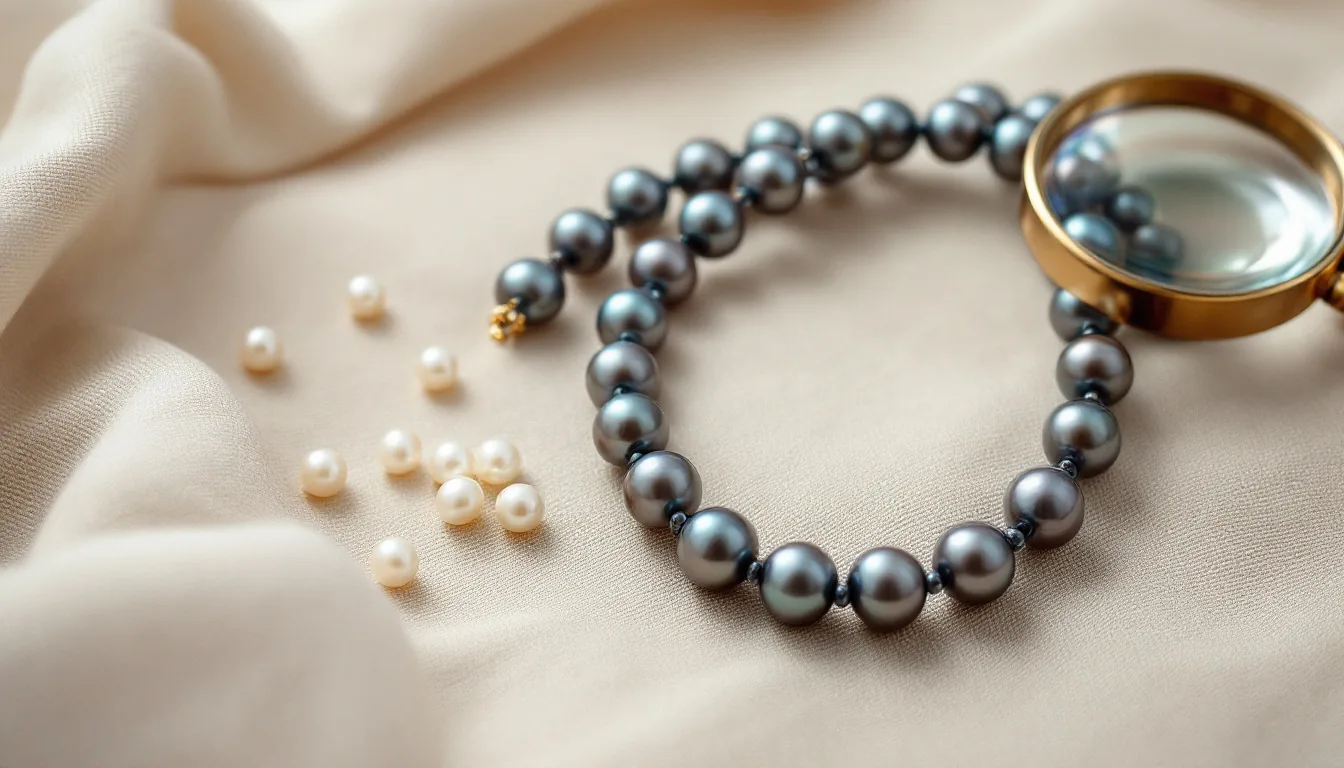
Cultured pearls are dyed or irradiated to turn white or off-color pearls into the darker, more saleable shades that buyers want, most often to imitate the natural black and gray of Tahitian pearls. At the counter, the strongest clues are dye concentrated around the drill hole, color that is suspiciously even across a whole strand, and a dark bead nucleus visible through the drill hole. A definitive answer needs a gemological laboratory with UV, X-ray and spectroscopic equipment.
Why pearls are treated
Natural-color dark pearls are scarce, and buyers pay for color. GIA’s 1989 review of Polynesian black pearls by Marisa Goebel and Dona Mary Dirlam explains that overharvesting of the black-lipped oyster, Pinctada margaritifera, in the 19th century had left natural black pearls in short supply by 1900. To fill the gap, treaters began dyeing smaller Akoya pearls black with silver nitrate solutions. The authors note that from 1900 until 1978, when cultured black pearls began appearing in quantity, treated black pearls far outnumbered natural-color ones on the market.
Treatment still serves the same purposes today:
- converting low-value white or off-color pearls into black, gray or fashion colors;
- matching pearls for a uniform strand;
- giving smaller, cheaper pearls the look of larger, rarer types.
The last purpose is where disclosure problems begin. A dyed Akoya and a natural-color Tahitian can sit side by side in a tray at very different true values.
The main treatments
Silver nitrate dyeing
According to Goebel and Dirlam, the basic process involves soaking pearls in a weak solution of silver nitrate and dilute ammonia, then exposing them to light or hydrogen sulfide gas. This changes the color of the conchiolin, the organic layer inside the pearl, so the pearl appears black in reflected light. The resulting color is stable to light and heat, and its brown-black, green-black and black hues are close enough to natural colors that visual inspection alone often cannot separate them. Silver treatment is not limited to Akoya pearls: the same article records the GIA laboratory examining dyed 12 mm black cultured pearls in 1989, with trade confirmation that some South Sea pearls were being darkened.
Organic and other dyes
Dyes are also used to produce the wide range of fashion colors seen in freshwater cultured pearls. GIA’s care guidance states plainly that the colors of such freshwater cultured pearls result from dyeing, and that dyed pearl colors can change over time.
Gamma irradiation
Irradiation with a cobalt-60 gamma source darkens pearls to gray, blue-gray or near black. Goebel and Dirlam, citing earlier Japanese research, report that irradiation of Akoya pearls began in the 1950s under the “Atoms for Peace” program, and that irradiated cultured pearls first appeared on the market in the 1960s.
The mechanism matters for identification. Freshwater shell, which is used almost exclusively for the bead nuclei of cultured pearls, darkens under irradiation. In a thin-nacred Akoya pearl, the darkened bead shows through and changes the body color, while the nacre itself is unchanged. In P. margaritifera pearls, the much thicker nacre hides any change in the nucleus. Freshwater pearls themselves also respond to irradiation more readily than saltwater pearls, which researchers have attributed to manganese compounds that are more abundant in freshwater mollusks.
Bleaching and other processes
Bleaching is the opposite of dyeing: it lightens dark conchiolin to produce whiter pearls. A 2004 Colored Stone article republished by Ganoksin described bleaching as routine for most white pearls other than South Sea and American freshwater types. GIA notes that excessive bleaching can make some pearls more fragile.
Tell-tale signs at the counter
None of these signs is proof on its own. Together they tell a buyer when to send pearls to a lab.
| Observation | What it suggests | Notes |
|---|---|---|
| Color concentrated around the drill hole, sometimes spreading in vein-like streaks | Dye | Use a loupe or microscope; the 1989 G&G article describes this pattern |
| Unusually even color through each pearl and across the whole strand | Dye | G&G notes dyed material can show this evenness, sometimes across an entire strand |
| Very dark bead nucleus visible through the drill hole, with normal-looking nacre | Irradiated bead-nucleated pearl, usually Akoya | Irradiation darkens the freshwater shell bead, not saltwater nacre |
| Intense color with a metallic luster | Possible treatment | Cited in G&G as an indicator, including on undrilled pearls |
| Small, round, very black, gray or green pearls of about 8 mm or less | Likely treated Akoya | Goebel and Dirlam called such pearls “generally treated”; a red flag, not a test |
| Fading or patchy color after a period of wear | Dye | GIA notes that dyed pearl colors can alter over time |
Natural-color black pearls
GIA describes Tahitian cultured pearls from P. margaritifera as ranging from gray to black to brown, with blue, green, purple or pink overtones. Their color comes partly from porphyrins in the nacre, compounds that also produce a diagnostic red fluorescence. Under long-wave UV, Goebel and Dirlam report that natural-color black pearls typically fluoresce from bright red (pearls from Baja California) to dull reddish brown (Tahitian pearls), while dyed pearls are usually inert or fluoresce a dull green.
There is a catch. Irradiation changes the color of the bead but not the pearl’s UV reaction, so an irradiated Akoya can still fluoresce like an untreated one. UV is a useful screen for dye, not a complete test.
How laboratories identify treatment
The 1989 review stressed that definitive pearl testing requires a well-equipped gemological or pearl-testing laboratory. The methods it describes are still the backbone of the work:
- Long-wave UV fluorescence to screen for dye and to confirm the reddish response typical of natural-color black pearls.
- X-ray fluorescence (XRF) to detect silver from silver-salt treatments. The authors note that energy-dispersive units are preferred because some pearls have darkened under wavelength-dispersive XRF.
- X-radiography, which shows internal structure. Silver tends to concentrate in the conchiolin layer around the nucleus, and because silver is opaque to X-rays it appears as a white ring or area on the image, sometimes called a reversal ring.
- Microscopy of the drill hole, surface and any blemishes for dye concentrations.
Older destructive tests, such as scraping the pearl to see whether the powder is white or black, or touching it with a weak nitric acid swab, can confirm some dyed pearls but damage them. They have no place in routine trade testing.
GIA’s pearl reports record quantity, weight, size, shape, color, origin, mollusk, environment (saltwater or freshwater) and any detectable treatments, for loose, mounted or strung pearls. For a strand being sold as natural-color Tahitian or South Sea cultured pearls at a premium, a report is the only reliable protection for buyer and seller.
Durability and care of treated pearls
GIA states that pearls may be dyed, impregnated or coated, that these treatments can alter over time, and that bleaching and irradiation can be stable during normal wear. Pearl is only 2.5 on the Mohs scale, and GIA lists hair spray, perfume, cosmetics and even perspiration among the chemicals that can damage it. For any cultured pearl, and especially a dyed one, that means:
- put pearls on after cosmetics and perfume, and wipe them with a very soft, clean cloth after each wearing;
- never use ultrasonic or steam cleaners;
- use warm, soapy water only for occasional thorough cleaning, and let the string dry completely before wearing;
- keep pearls away from high heat, which GIA warns can burn or discolor them;
- check for color loss around drill holes when pearls come in for restringing.
Disclosure
The US FTC Jewelry Guides address pearl treatments directly. Under 16 CFR 23.23, a seller should disclose that a pearl or cultured pearl has been treated if the treatment is not permanent, if it creates special care requirements, or if it significantly affects the pearl’s value. The Guides add that disclosure applies at every level of trade and, for online, catalog or televised sales, should appear in the product description.
In plain English: dyed pearls should be disclosed because dye may not be permanent and the treatment affects value. Irradiated pearls should be disclosed because the treatment significantly affects value, even though the color is stable. Separately, 16 CFR 23.20 says the word “pearl” should not be used for a cultured pearl unless it is immediately preceded, with equal conspicuousness, by “cultured” or a similar word. A dyed Akoya sold simply as a “black pearl” fails on both counts. The 2004 Colored Stone article observed that the FTC’s pearl-disclosure guidance was widely ignored at the time, which is a reason to be more careful, not less. This is a summary, not legal advice.
Common questions
Can a jeweler tell dyed from natural-color pearls with a loupe? Sometimes. Dye pooling at the drill hole is a clear sign, but well-treated pearls may show nothing obvious. A lab test is needed for certainty.
Is a dark pearl over 10 mm safe to assume natural color? No. The 1989 G&G review recorded dyed black cultured pearls of 11 to 14 mm and 12 mm, including South Sea material. Size narrows the possibilities but does not settle them.
Further reading
- Goebel and Dirlam (1989), Polynesian Black Pearls, Gems & Gemology 25(3)
- GIA: Pearl Care and Cleaning
- GIA: Pearl Description
- GIA: Pearl Identification and Analysis Reports
- FTC Jewelry Guides, 16 CFR 23.23: Disclosure of treatments to pearls and cultured pearls
- Ganoksin: Pearl Treatments Explained (Anne Sasso, Colored Stone, 2004)