Colombian Emeralds: Muzo, Chivor and the History of the Trade
Where Colombian emeralds are mined, the Green War and 1990 peace, Víctor Carranza's role, three-phase inclusions, oil and resin fillers, and origin reports.
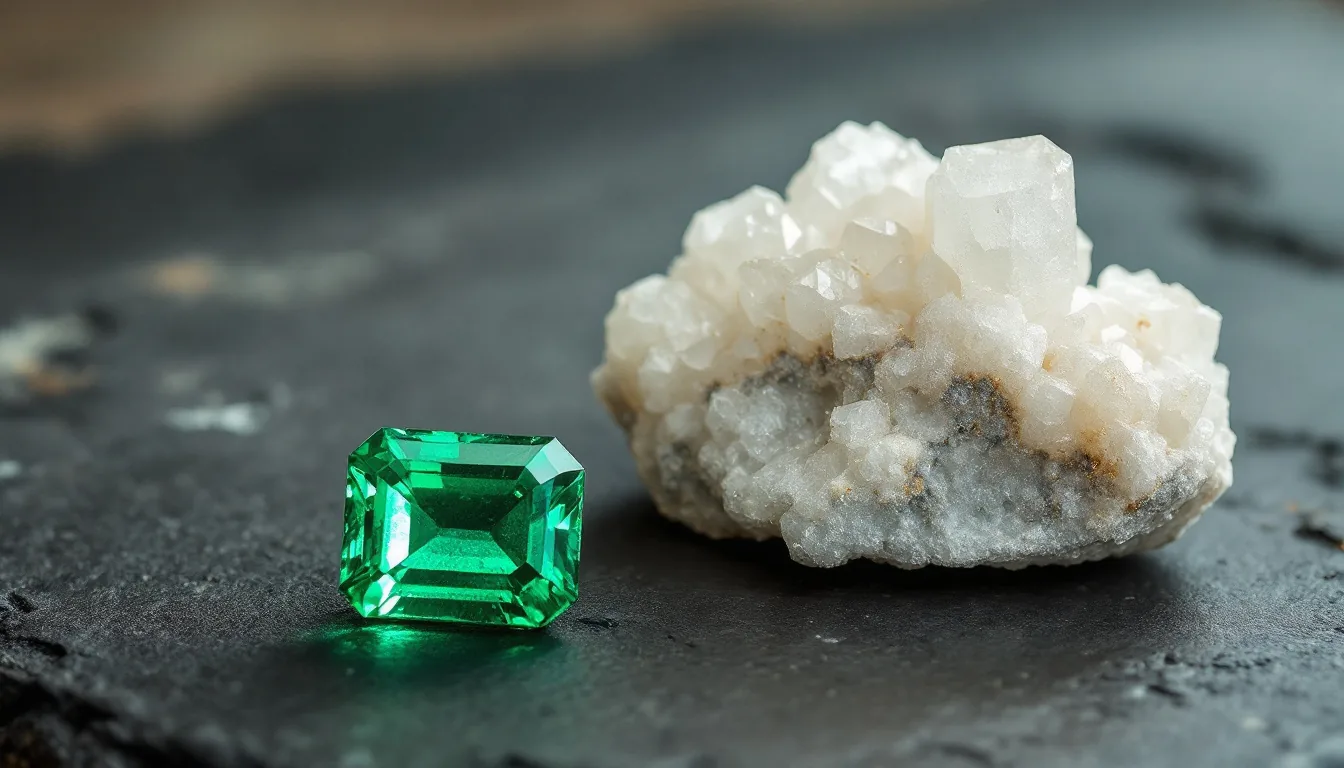
Colombian emeralds come from two narrow belts in the Eastern Cordillera of the Andes: a western belt around Muzo and Coscuez, and an eastern belt around Chivor and Gachalá. The trade has a violent modern history, including the “Green War” of the 1980s, which ended with a Church-mediated peace in 1990 in which the dealer Víctor Carranza played a central part. For buyers today, two technical questions matter most: nearly all emeralds are clarity-enhanced with oil or resin, which should be disclosed, and a “Colombian” origin is a laboratory opinion built on inclusions and chemistry, not on color.
Where the emeralds are mined
| Belt | Main mining areas | Notes |
|---|---|---|
| Western | Muzo, Coscuez, La Pita, Peñas Blancas, La Glorieta–Yacopí; the Maripí area | Colombia’s most productive mines. Mineralization about 33 million years ago. The source of trapiche emeralds. |
| Eastern | Chivor, Gachalá, Macanal | Smaller output, but capable of fine stones. Mineralization about 65 million years ago. |
Both belts sit in Lower Cretaceous black shales. According to a 2017 Gems & Gemology field report, Colombia’s deposits are of the sedimentary type, unlike most of the world’s production, which comes from deposits linked to magmatic rocks. In the western belt, hot brines, created when heated fluids dissolved buried salt layers, moved up through faults in the shale and picked up the elements needed for beryl. As the brines cooled, emerald crystallized in veins with calcite, quartz, albite and pyrite. That salty fluid helps explain why Colombian emeralds so often trap tiny salt crystals, as described below.
Each area has a reputation. A 2016 G&G report described Chivor stones as bright green tinged with blue and relatively clean. Trapiche emeralds, whose texture resembles a wheel with six spokes, are found only in the black shales of the western zone, G&G reported in 2015. GIA also cautions that color overlaps between sources, so no color is proof of origin.
A short history
Emeralds were mined by the indigenous peoples of what is now Boyacá long before the Spanish arrived. According to G&G’s 2016 history of Chivor:
- 1537. The conquistador Gonzalo Jiménez de Quesada reached the Eastern Cordillera, where his men were led to a deposit known as Somondoco, later called Chivor. Chivor is credited as the source of the first New World emeralds exported to Europe.
- About 1558. Production began at Muzo, which proved far richer.
- 1593 to 1602. Spain issued a royal decree in 1593 on the humane treatment of indigenous miners, but by the time Philip III demanded its enforcement in 1602, the Chibcha labor force had been almost destroyed.
- 1672. Chivor was abandoned on the order of Carlos II and overgrown by jungle.
- 1896. Francisco Restrepo rediscovered Chivor. The German Fritz Klein joined him in 1911, and the mining engineer Peter Rainier took over the mine in 1926, later describing it in his 1942 memoir Green Fire.
After independence, the former royal mines passed to the Colombian state, while independent diggers, called guaqueros, kept working the area. By 1979, G&G reports, two companies had begun privatized mining: Tecminas at Muzo and Esmeracol at Coscuez.
The Green War and the 1990 peace
G&G’s 2017 report says relations between the two companies became strained and that elements of the drug cartels tried to move into the emerald business in the 1980s, leading to the Green War, in which thousands died. InSight Crime, a research organization that studies organized crime, put the toll at an estimated 6,000. The Catholic Church mediated a peace agreement in 1990. One tunnel at Coscuez, La Paz (“peace”), was named for the agreement, its manager told GIA’s team.
Víctor Carranza
Víctor Carranza, born in 1935 in Guateque, Boyacá, was known as Colombia’s “emerald czar.” G&G describes him as the most influential figure in the industry at the time of the peace and as instrumental in the treaty. InSight Crime reported that the agreement was enforced with his help.
He was also a contested figure. In 1998 he was arrested and charged with kidnapping and with forming illegal right-wing militias, according to the Associated Press. After about three years in jail he was freed and the charges were dropped. The AP reported that some demobilized paramilitary commanders later named him as one of their own; he was never convicted. He died of lung cancer in Bogotá on April 4, 2013, aged 77. As his health failed and after his death, InSight Crime reported a wave of targeted killings in the emerald zone, with the Church and the national government working to maintain the 1990 agreements.
The trade today
Colombia exported more than 2 million carats of emerald worth $147 million in 2014, mostly to the US and Asia, G&G reported. Its 2017 field report found:
- Formalization. Emerald traders had to register with the national mining agency under a system called RUCOM; registrations grew from 178 in 2015 to 5,150 by 2017.
- Corporate mining. A multinational operator, MTC, ran a large mine at Muzo, and its stones were cut in Bogotá with a per-stone traceability certificate recording the date and place of extraction and declaring the filler used. Gemfields acquired 70 percent of Coscuez in 2015 but later pulled back to focus on Africa.
- Bogotá’s cutting and trading center. The Emerald Trade Center, built in 1963, housed dealers and cutters. The CDTEC laboratory, founded in 2008, certified Colombian origin and treatments and examined about 70 percent of the high-end goods leaving the country.
Three-phase inclusions
The classic sign of a Colombian emerald is the three-phase inclusion: a cavity holding liquid, a gas bubble and a tiny crystal of salt. GIA’s 2019 study of emerald origin describes the typical Colombian form as a jagged cavity with a gas bubble and a cubic crystal, usually halite and/or sylvite, measuring from 100 micrometers to 1 millimeter.
They are not proof on their own. A 2014 G&G study found similar inclusions in emeralds from Afghanistan’s Panjshir Valley, from Davdar in China and from Kafubu and Musakashi in Zambia. GIA’s 2019 paper treats only large jagged inclusions, over about 0.5 mm, as diagnostic of Colombia; smaller ones need other evidence. Another strong indicator is gota de aceite (“drop of oil”), a roiled growth feature most common in Colombian stones. Common solid inclusions include carbonates and pyrite.
Oil, resin and disclosure
GIA’s care guide says some estimates put the share of fracture-filled emeralds at 90 percent or more. Filling surface-reaching fractures with a substance of similar refractive index makes them much less visible. Gems & Gemology’s 1999 study of fillers grouped them as:
| Group | Examples | Notes |
|---|---|---|
| Presumed natural | Essential oils such as cedarwood oil, other oils, waxes | Cedarwood oil and Canada balsam were long considered the “traditional” fillers. |
| Artificial resins | Epoxy prepolymers, other prepolymers including UV-setting adhesives, polymers | Opticon, an epoxy resin, became a newer substitute; some markets pay less for resin-filled stones. |
Whatever their composition, fillers with a refractive index of 1.54 or more can show “flash effects,” and finding one filler does not rule out others, the study noted. GIA reports describe clarity enhancement as minor, moderate or significant, and in late 2024 GIA added an optional service identifying filler as Type A (oil, wax and/or natural resin) or Type B (artificial resin).
Fillers affect care and bench work. Studies cited by G&G found that both traditional fillers and Opticon were affected by routine cleaning and jewelry manufacturing. GIA advises against ultrasonic and steam cleaning: vibration can weaken fractured stones, and steam can make oil or unhardened resin sweat out. Light and chemicals can also alter fillers. Warm, soapy water with gentle scrubbing is safest.
Disclosure in plain English. Under the FTC Jewelry Guides (16 CFR 23.24), a seller should disclose a gemstone treatment if it is not permanent, creates special care requirements or significantly affects value. Emerald fillers can deteriorate and call for gentle cleaning, so filled emeralds should be disclosed as treated, with care instructions, at every level of trade and in online listings. Separately, 16 CFR 23.25 says a laboratory-grown emerald must be qualified with a term such as “laboratory-created.” This is a summary, not legal advice.
How laboratories report origin
According to GIA’s 2019 paper, labs combine three lines of evidence:
- Microscopy for inclusions such as jagged three-phase cavities and gota de aceite.
- UV-Vis-NIR spectroscopy. A typical Colombian spectrum shows chromium bands and lacks the iron-related absorption in the near-infrared that marks iron-rich emeralds.
- Trace-element chemistry by laser ablation ICP-MS. Colombian emeralds tend to be the chemically purest, low in lithium, potassium, rubidium, cesium and iron.
Inclusions and spectra can often separate Colombian stones from others, though there is overlap with Afghan and Chinese material, and some stones lack diagnostic features. Origin on a report is therefore an opinion, given when the evidence allows and the client requests it, alongside a statement of any treatment.
Questions
Does a three-phase inclusion prove an emerald is Colombian?
No. It is a strong clue, and very large jagged three-phase inclusions are considered diagnostic, but similar inclusions occur in emeralds from Afghanistan, China and Zambia.
Is a filled emerald a poor buy?
Not necessarily. Filling is normal in the emerald trade. What matters is disclosure, the type and degree of filler, and price, which should reflect both.
Further reading
- Gems & Gemology: Colombian Emerald Industry, Winds of Change (Fall 2017)
- Gems & Gemology: In Rainier's Footsteps, Journey to the Chivor Emerald Mine (Summer 2016)
- Gems & Gemology: Geographic Origin Determination of Emerald (Winter 2019)
- Gems & Gemology: Three-Phase Inclusions in Emerald and Their Impact on Origin Determination (Summer 2014)
- GIA: Emerald Care and Cleaning Guide
- FTC Jewelry Guides, 16 CFR 23.24: Disclosure of treatments to gemstones