How to Remove and Refit a Watch Stem and Crown
How to release a watch stem with a push-piece or setting-lever screw, refit it, check the crown positions, handle screw-down crowns, and know when to stop.
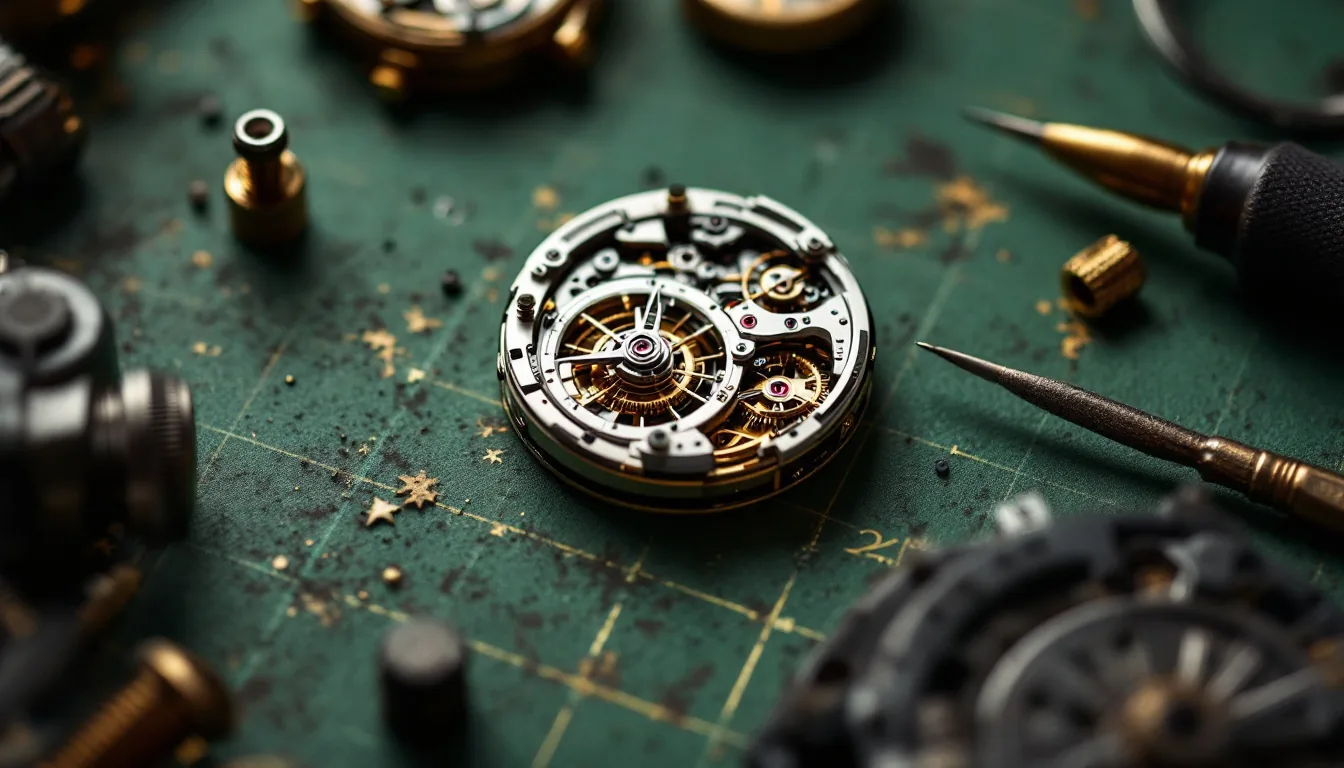
To remove a watch stem, open the case back and find the stem release on the movement. On most watches it is a small push-piece beside the stem; on others it is a setting-lever screw. Press the push-piece, or loosen the screw a few turns, while drawing the crown straight out. Refitting reverses the process, then the crown must be checked in every position and the case resealed.
Why the stem stays in
The crown and stem drive the keyless works, the mechanism that winds the mainspring and sets the hands. Walt Odets’s TimeZone explanation of the keyless works describes how a pin on the setting lever (also called the pull-out piece) sits in a groove on the stem. That connection holds the stem in the movement, and as the crown is pulled out, the setting lever rotates and moves the clutch from the winding position to the hand-setting position.
To remove the stem, the setting lever has to be moved just enough to free its pin from the groove. Movements do this in one of two ways.
| Release type | How to recognize it | How to release | Watch for |
|---|---|---|---|
| Push-piece | A small dimple or button on the movement near the stem | Press gently with tweezers or a fine pointed tool while pulling the stem | On some movements it is only visible with the crown in the time-setting position |
| Setting-lever screw | A screw on the movement beside the stem | Loosen it a few turns, then pull the stem; do not remove the screw | Retighten after refitting, or the stem will pull out again |
Esslinger’s repair guides note that screw-type retention is the less common of the two.
Tools
- The right case opener: a case knife for snap-on backs, an adjustable case wrench for screw-on backs
- A movement holder or a clean, soft surface such as a Selvyt cloth or pith
- Fine tweezers (brass or plastic tips are kinder to the movement)
- A screwdriver sized exactly to the setting-lever screw, if there is one
- A loupe, pegwood and a dust cover to protect the open movement
Removing the stem
- Note what the crown does. Count the positions (winding, date setting if fitted, time setting) before taking anything apart, so you can confirm them on reassembly.
- Unscrew a screw-down crown first. Turn it counterclockwise until it springs free of the case tube.
- Open the case on a clean, padded surface and keep the movement covered when you are not working on it.
- Find the release. Look on the movement next to the stem. If you cannot find a push-piece, pull the crown in and out through its positions; Esslinger’s guide notes that on some movements the dimple only appears with the stem in the time-setting position.
- Release and withdraw. Press the push-piece gently with tweezers, or loosen the setting-lever screw a few turns (Esslinger’s guide suggests three to four, counterclockwise), and draw the crown straight out. It should slide out without much force. If it resists, stop: the release has not been found or is not fully engaged.
- Keep pulls straight. Odets points out that the stem is designed for rotational force, not side loads, and that lateral pressure wears it and can eventually break it at the setting-lever groove.
With the stem out, the movement can usually be lifted from the case, depending on how the case is built.
Refitting the stem
- Inspect the stem and crown. Look for a bent stem, damaged threads, and a worn or missing crown gasket.
- Insert the stem straight. If it stops partway, rotate it gently so its squared section lines up with the clutch wheel. On some movements the release must be pressed again while the stem goes in.
- Push it home until it engages. You should feel the setting lever pick up the groove.
- Retighten the screw on a screw-type movement, turning it clockwise until snug and no more.
- Check every position. Push the crown in and wind a few turns; pull it to each stop and confirm the date (if fitted) and the hands move as they should; then push it back in. The crown should click positively into each position and must not pull out past the last one.
- Check the fit to the case. With the movement cased, the crown should sit close to the case without binding.
Fitting a replacement stem
A new stem is ordered to suit the movement caliber, then usually cut to length for the case. Esslinger’s method holds the stem in a pin vise and threads the crown on three to four turns to test the fit. If the crown stands too far from the case, the threaded end is cut down in small steps with end cutters, filed at about 45 degrees so the crown will start cleanly, and tried again. Once the length is right, a push-on crown is fixed to the stem; Esslinger uses two-part epoxy and says the method does not apply to screw-down crowns.
Screw-down crowns and water resistance
A screw-down crown threads onto a tube in the case, compressing a gasket so water cannot follow the stem into the case. Rolex’s Oyster case, introduced in 1926, was an early and influential example.
- To refit, push the crown against the tube and turn it clockwise while pressing gently until the threads catch, then screw it down finger-tight. If it resists early, back it off and start again; a cross-threaded crown can ruin the tube.
- Do not overtighten, which can damage the threads or crush the gasket.
- Treat any opened case as untested. Removing the stem and case back disturbs gaskets. A watch sold as water-resistant should have its gaskets inspected or replaced and be pressure tested before it goes near water again. The international standards are ISO 22810 for water-resistant watches in general and ISO 6425 for divers’ watches.
When to leave it to a watchmaker
- divers’ watches, or any watch the owner relies on for water resistance, unless a pressure tester is available
- screw-down crowns with stiff, damaged or cross-threaded threads
- chronographs and other complicated movements
- watches with one-piece cases that load through the crystal
- a stem that has broken off inside the movement
- valuable, vintage or antique pieces, where a slip can cost more than the repair
- watches still under a manufacturer’s warranty, whose service policies may restrict who can open them
The American Watchmakers-Clockmakers Institute keeps a directory of members and a brand directory of service policies. Its CW21 (Certified Watchmaker of the 21st Century) credential involves a three-day examination covering four major areas of watchmaking, with continuing education required to stay current.
Common questions
Why does the stem pull straight out after refitting?
The setting lever has not engaged the groove. On a screw-type movement, the screw has not been retightened; on a push-piece movement, the stem may not be fully home, or the release may be stuck down.
The crown turns but nothing happens. Is the stem broken?
Possibly. A crown that has come loose from the stem, a crown with the wrong thread for the stem, or a stem broken off inside the movement can all cause it. Remove the stem and look at it; if the inner end is missing, the broken piece is still in the movement, which is a job for a watchmaker.
Can I remove the stem without opening the case?
Not on a conventional case. The release is on the movement, so the case back has to come off.
Further reading
- TimeZone: The Keyless Works, by Walt Odets (2002)
- Esslinger: How to Remove a Watch Stem, Push Style Stem Removal
- Esslinger: How to Remove a Stem, Screw Type Stem Removal
- Esslinger: How to Replace a Watch Stem
- Esslinger: How to Replace a Watch Crown
- American Watchmakers-Clockmakers Institute: CW21 Certification