Moissanite vs Diamond: Properties, Testing and Disclosure
How moissanite differs from diamond in refractive index, dispersion, hardness and density, why thermal testers miss it, and how to describe it correctly.
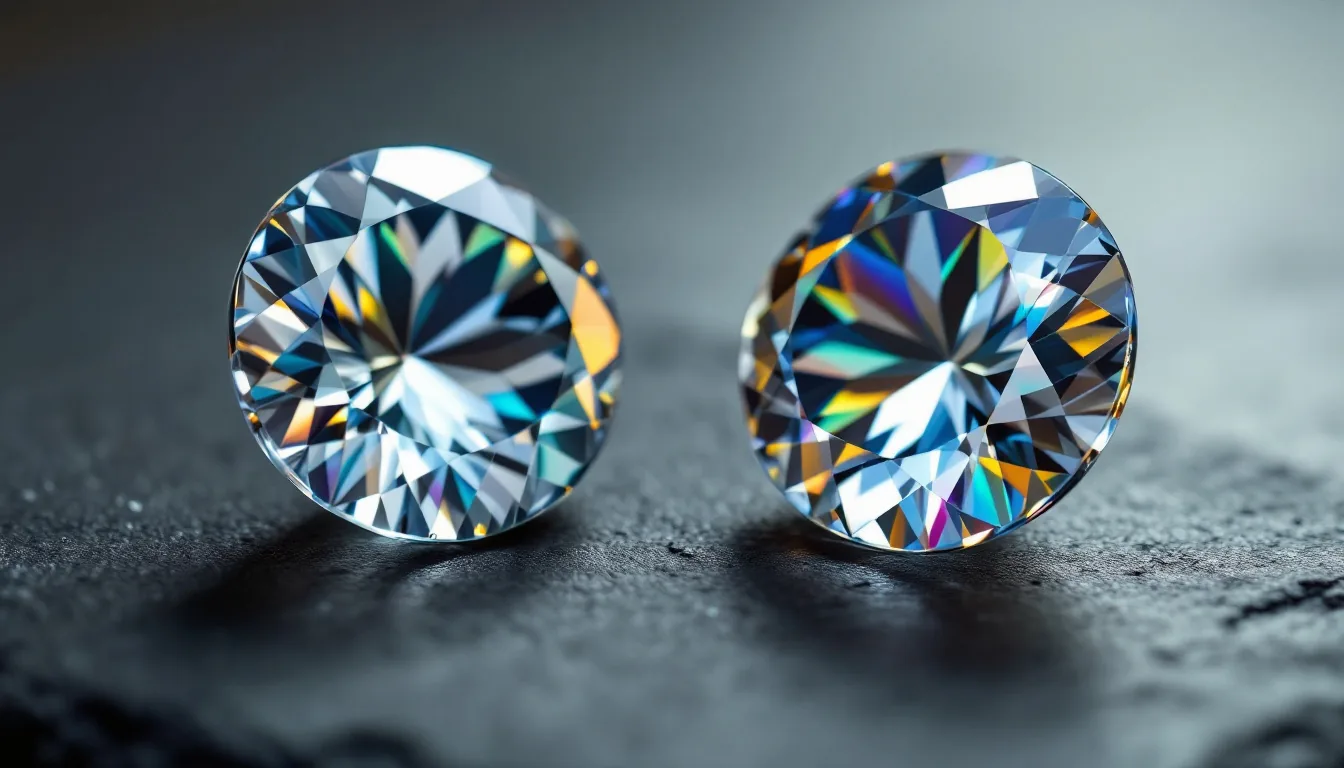
Moissanite is silicon carbide, a different material from diamond, and the stones sold in jewelry are laboratory-made. It is slightly less hard and noticeably less dense than diamond, more strongly refractive, more than twice as dispersive, and doubly refractive where diamond is not. Because its heat conduction is close to diamond’s, a basic thermal tester reads it as “diamond,” so separating the two takes a different test or a few minutes with a loupe.
From meteorite to jewelry counter
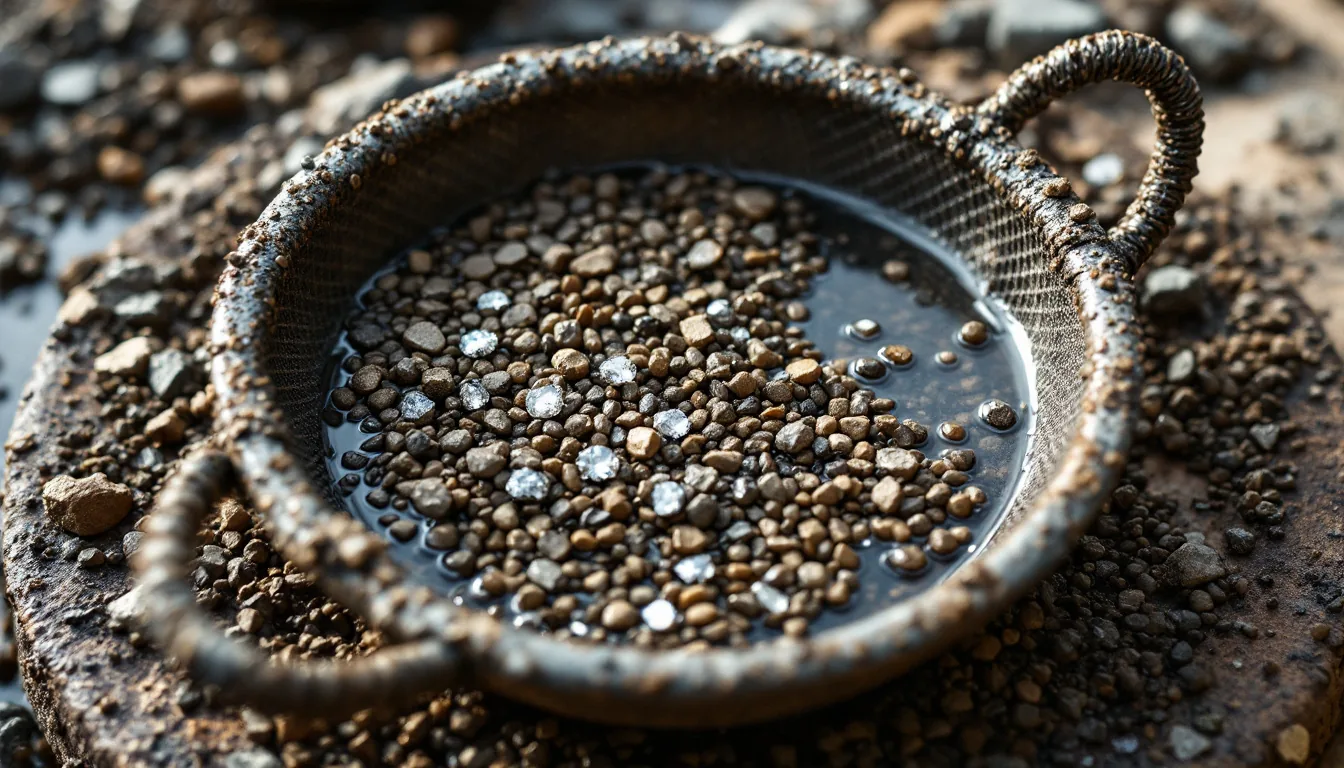
Silicon carbide was a manufactured material before it was known as a mineral. Edward G. Acheson, the first to recognize its value as an abrasive, made it by accident while trying to grow diamond and named it “carborundum.” It is still produced in bulk for abrasives.
The Nobel Prize-winning chemist Henri Moissan then found natural silicon carbide in the Canyon Diablo meteorite from Arizona, publishing his identification in 1904. The following year, the gemologist George F. Kunz named the mineral moissanite in Moissan’s honor. Natural moissanite has since been confirmed as tiny inclusions in diamond crystals, but it occurs only in minute amounts.
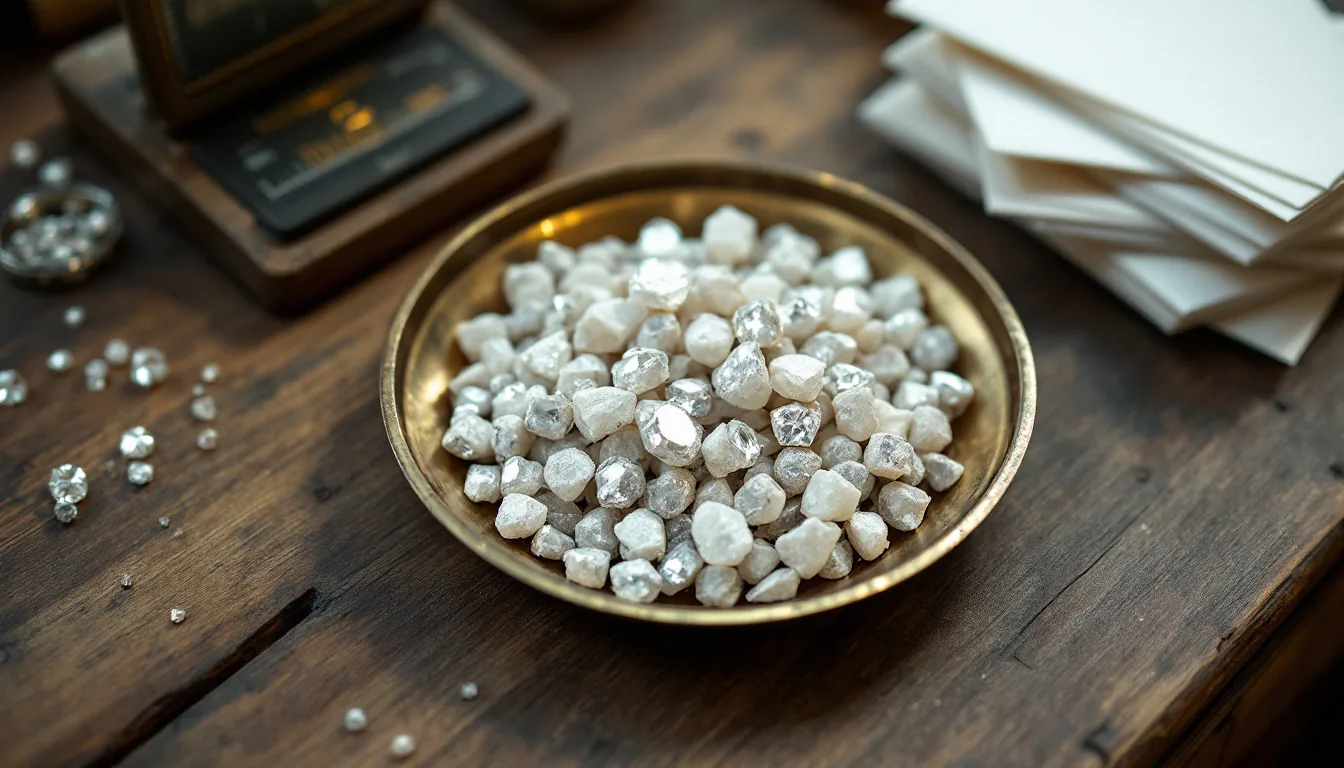
Gem moissanite became possible once the electronics industry learned to grow large single crystals of silicon carbide for semiconductors. Cree Research of Durham, North Carolina, which grew silicon carbide for electronics, produced near-colorless crystals of the 6H polytype, and C3 Inc. distributed them as gems. GIA researchers described the material in the Winter 1997 issue of Gems & Gemology, warning that it passed thermal diamond testers. C3 told them it planned to price stones at 5 to 10 percent of the retail price of comparable diamonds.
C3, which later became Charles & Colvard, reported that it began shipping moissanite to US retail jewelers and international distributors in the second quarter of 1998. The company’s US patents on moissanite jewels expired in 2015, and it now markets its stones as “created moissanite.”
Properties compared
| Property | Diamond | Moissanite (6H silicon carbide) |
|---|---|---|
| Composition | Carbon | Silicon carbide |
| Crystal system | Cubic | Hexagonal |
| Optic character | Singly refractive | Doubly refractive (uniaxial positive) |
| Refractive index | 2.417 | 2.648 to 2.691 |
| Birefringence | None | 0.043 |
| Dispersion | 0.044 | 0.104 |
| Mohs hardness | 10 | 9¼ |
| Specific gravity | 3.52 | 3.22 |
| Thermal tester reading | Diamond | Diamond |
| Electrical conductivity | Most colorless stones none | Often conductive |
| Near-ultraviolet | Transmits | Absorbs (below about 425 nm) |
Figures are from GIA’s 1997 study unless noted. The dispersion figure explains the look: moissanite shows much stronger flashes of spectral color than diamond, an effect that becomes more obvious as stones get larger. The Mohs number understates the gap in hardness. On the Knoop indentation scale, the step from corundum (Mohs 9) up to moissanite is larger than the step from topaz (Mohs 8) to corundum, which is why the material needed a special polishing process.
Why thermal testers fail
A thermal tester measures how quickly a stone draws heat away from a heated tip. Diamond does this far better than cubic zirconia, glass or other older simulants, which is why jewelers relied on the probes for many years.
Moissanite breaks that rule. GIA’s 1997 study noted that the published thermal inertia ranges of diamond and moissanite overlap, then tested 23 moissanites on four thermal instruments. Every one registered as “diamond.” The authors warned that a jeweler relying only on a thermal probe could misidentify moissanite as diamond.
How moissanite testers work
The first dedicated tester came from C3 itself. Its Colorless Moissanite/Diamond Tester Model 590 measured transparency in the near-ultraviolet, where diamond transmits and moissanite absorbs. The instructions said to use it only on stones a thermal probe had already called “diamond,” and GIA found the two-step approach conclusive.
Combination testers, often sold as multi-testers, add an electrical conductivity test to the thermal probe, since many moissanites conduct electricity and most colorless diamonds do not. Treat that reading with care:
- GIA’s 1997 study called conductivity “indicative” but never diagnostic.
- Blue and gray type IIb diamonds, natural or laboratory-grown, contain boron, which makes them semiconductors. A conductivity tester can flag a genuine blue diamond as moissanite.
- No counter tester separates natural from laboratory-grown diamond. That needs a dedicated screening device or a laboratory.
Gemological tests that settle it
Standard gemological tools will separate moissanite from diamond, and several tests are definitive on their own.
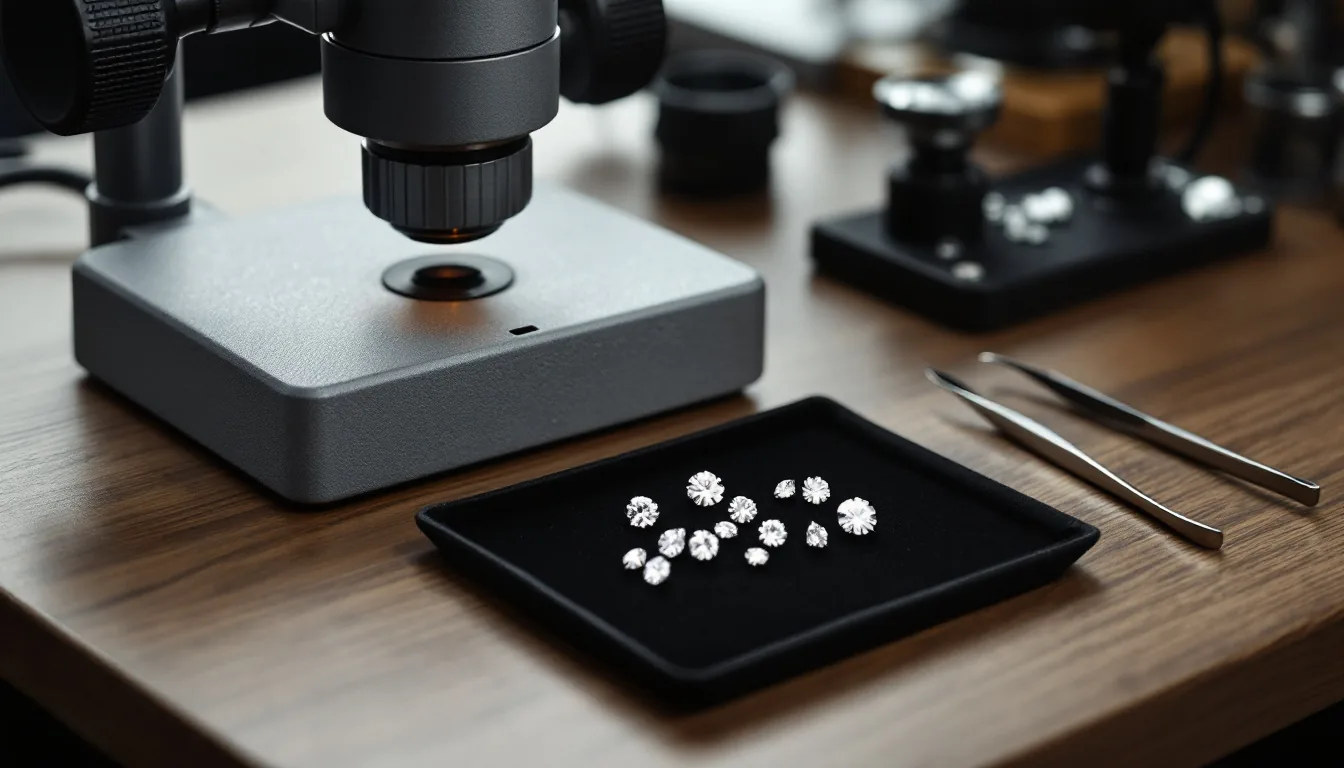
- Look for doubling. View the stone at an angle through the crown facets with a 10x loupe or microscope. In moissanite the pavilion facet junctions appear doubled. Cutters usually orient the table perpendicular to the optic axis, so a straight-down view may show no doubling; tilt the stone or focus past the culet to see doubled reflections.
- Check the inclusions. The most common inclusions GIA found were fine white needles running parallel to one another and perpendicular to the table. Diamond-type features such as strain, cleavages or included crystals of other minerals were absent.
- Inspect the polish. Moissanites in the 1997 study often had rounded facet junctions and polish lines running in the same direction across adjacent facets, which does not happen in diamond.
- Use specific gravity. In methylene iodide (S.G. 3.32), moissanite floats and diamond sinks. This also separates mixed parcels quickly. Heavy liquids are toxic, so use them only with gloves, ventilation and the supplier’s safety data sheet.
- Confirm with instruments if needed. A reflectivity meter separates the two by refractive index. A laboratory can confirm with Raman spectroscopy, where moissanite lacks diamond’s 1332 cm⁻¹ peak, or with X-ray fluorescence, which detects silicon.
As the GIA authors noted, many tests prove a stone is not diamond; calling it moissanite requires several features that agree.
Disclosure
Moissanite is the name of a natural mineral, and jewelry moissanite is made in a factory, so it should be sold as a laboratory-created product. Under the US Federal Trade Commission’s Jewelry Guides, the name of a gem used for a laboratory-made stone should be immediately preceded, just as prominently, by a word such as “laboratory-created,” “laboratory-grown” or “[manufacturer name]-created.” Words such as “real,” “genuine” and “natural” must not be used for manufactured products.
Moissanite must never be described as diamond, lab diamond or a type of diamond. If a seller presents it as a diamond alternative and uses the word “diamond” at all, the Guides call for “simulated” or “imitation” directly before it. In April 2019, FTC staff sent warning letters to eight jewelry marketers over ads that might imply a simulant was a lab-grown or mined diamond. This is a plain-English summary rather than legal advice.
For jewelers taking in repairs or buying from the public, the practical point is simpler. A stone that passes a thermal probe is not proven to be diamond. Check it for doubling before quoting, setting or buying.
Common questions
Is moissanite a lab-grown diamond?
No. A lab-grown diamond is carbon with diamond’s crystal structure and properties. Moissanite is silicon carbide, with different optical and physical properties, and it is classed as a diamond simulant.
Can moissanite be set and repaired like diamond?
GIA’s 1997 study recorded moissanites cast in place in a gold ring without apparent damage, and the manufacturer reported no problems with conventional setting, repair and cleaning. Its high hardness and toughness make it durable for everyday wear.
Further reading
- Gems & Gemology (Winter 1997): Synthetic Moissanite: A New Diamond Substitute (Nassau, McClure, Elen and Shigley)
- Charles & Colvard, Ltd. (formerly C3, Inc.), Form 10-K405 filed March 2002, SEC EDGAR
- Charles & Colvard, Ltd., Form 10-K filed September 2022, SEC EDGAR
- Gems & Gemology (Summer 2018): Natural-Color Blue, Gray, and Violet Diamonds: Allure of the Deep
- FTC Jewelry Guides, 16 CFR 23.25: Misuse of the words ruby, sapphire, emerald, gem, etc.
- FTC: Warning Letters to Companies Regarding Diamond Ad Disclosures (April 2019)