The Diamond Pipeline: How Rough Diamonds Reach the Jeweler
How a rough diamond moves from mine to sorting, sights, tenders and auctions, cutting centers, bourses and retail, and how traceability works today.

A natural diamond usually changes hands several times before it reaches a jeweler. The miner sells the rough through contract sales, tenders or auctions; a manufacturer cuts it, mostly in India; dealers trade it through centers such as Antwerp, Dubai and Ramat Gan; and a jeweler buys it, often with a grading report. Each step has its own paperwork, and that paperwork, rather than anything measurable in the stone, is what proves where a diamond came from.
The pipeline at a glance
| Stage | Main players | What happens | Key paperwork |
|---|---|---|---|
| Mining and recovery | Producers and their government partners; artisanal diggers | Ore is crushed and diamonds recovered | Kimberley Process certificate when rough is exported |
| Sorting and valuation | Producers’ sorting houses, government valuators | Rough is sorted into thousands of categories and priced | Valuation records |
| Primary sales | Sightholders, tender and auction buyers | Producers sell rough to manufacturers and dealers | Contracts, KP certificates, warranty invoices |
| Rough trading | Dealers in trading centers | Parcels are split, re-mixed and resold | KP certificates, warranty invoices |
| Manufacturing | Cutting factories | Rough is planned, sawn, bruted and polished | Factory chain-of-custody records |
| Polished trading and grading | Bourse dealers, grading laboratories | Stones are graded and traded | Grading reports, warranty invoices |
| Jewelry and retail | Manufacturers, retailers | Stones are set and sold | Retail disclosures, origin claims where offered |
Mining, recovery and sorting
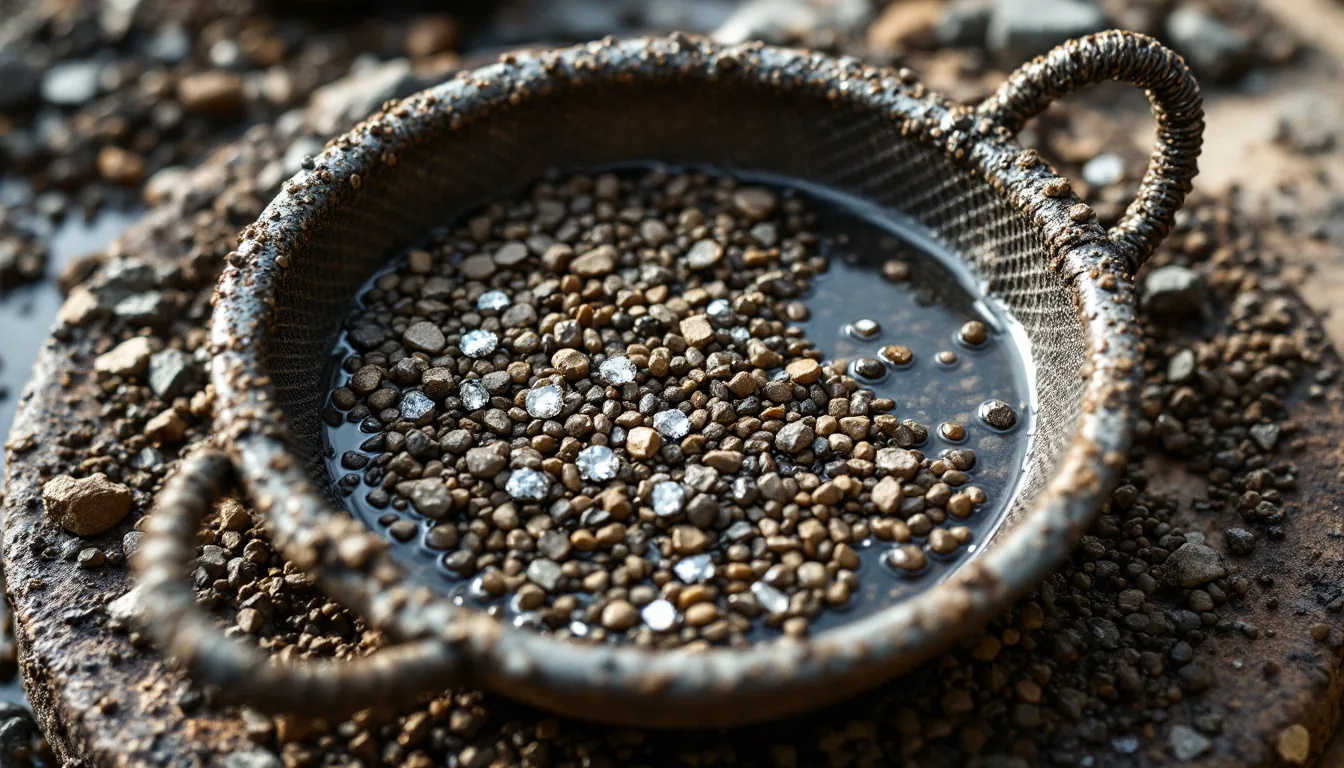
At large mines the process is heavily automated. Writing about Botswana’s Debswana mines in 2014, Gems & Gemology described ore being crushed, cleaned of clay and passed through an automated recovery plant where X-ray sorting separates the diamonds and, as a theft countermeasure, no one touches the ore.
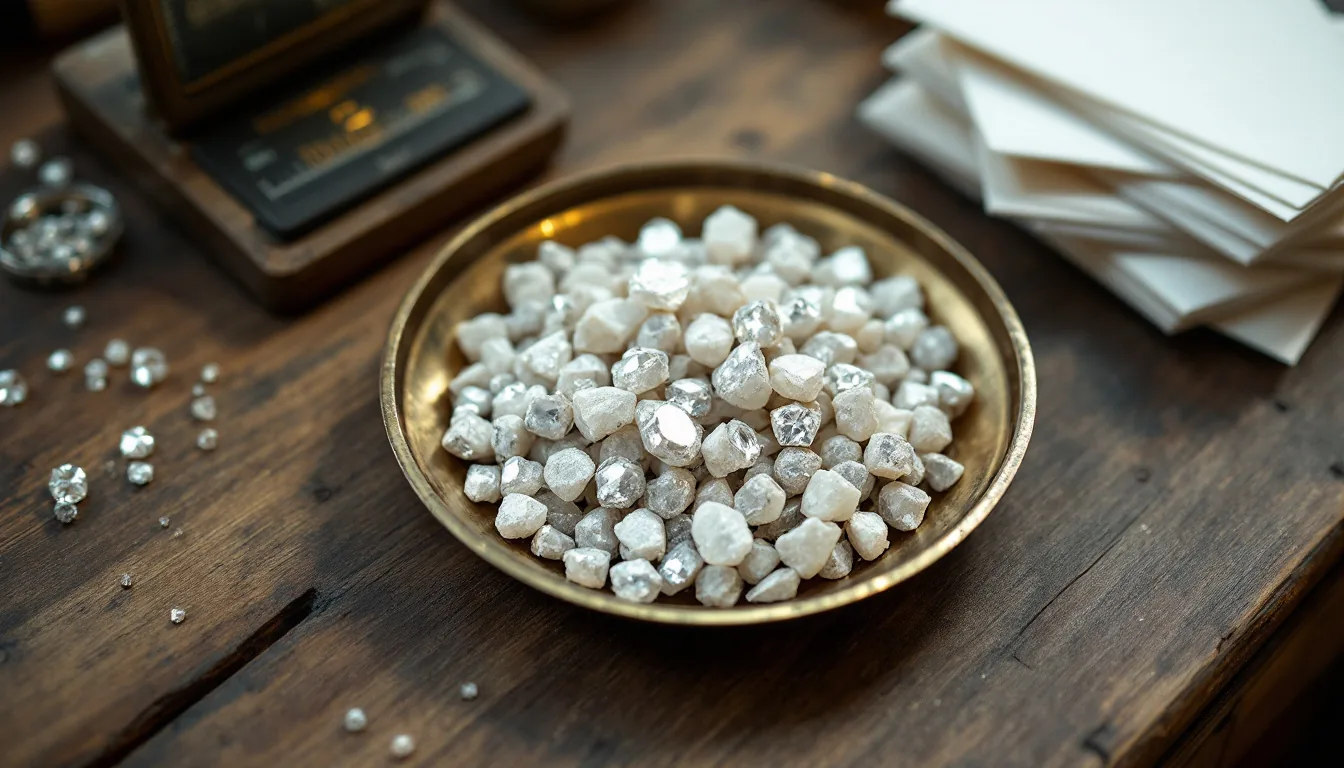
The recovered rough is then sorted by weight, shape, clarity and color. De Beers’s sorting and valuing center in Gaborone, DTC Botswana, could handle almost 45 million carats a year when G&G reported on it in 2014, about 40 percent of world supply at the time. From November 2013, G&G reported, all of De Beers’s mine production, from Botswana, Namibia, South Africa and Canada, was aggregated there before sale. Sorting is fine-grained: when BHP Billiton sold rough from Canada’s Ekati mine, it used about 4,000 categories, or “price points,” much as De Beers did.
Producer governments increasingly take a share of the rough to sell themselves. Botswana’s Okavango Diamond Company, set up in 2012, began with 10 to 15 percent of Debswana’s output. Under the agreement in principle Botswana and De Beers announced in 2023, ODC’s share starts at 30 percent and rises to 50 percent by the final year of the 10-year contract, according to De Beers.
How rough is first sold
Sights
For most of the 20th century, De Beers dominated rough sales. GIA’s Russell Shor has traced how Ernest Oppenheimer set up the Diamond Trading Company in the 1930s and the sight system that went with it: selected clients, called sightholders, bought mixed assortments of rough at set prices at 10 sights a year, on a take-it-or-leave-it basis. Through nearly all of the century, Shor writes, De Beers commanded 75 to 80 percent of world rough sales.
Two changes reshaped the system. In 2000 De Beers announced “Supplier of Choice,” which put sightholders on fixed-term contracts and pushed them to invest in branding and marketing. In 2013 the sights moved from London, where they had been held for close to a century, to Gaborone. De Beers says its Global Sightholder Sales now sells around 90 percent of its rough by value, at 10 sights a year held in Botswana, Namibia and South Africa.
Tenders and auctions
A tender is a silent auction: buyers inspect the goods and submit written bids, and the highest bid wins when the sale closes. A live auction takes bids in real time, usually online. Small producers adopted these methods in the early 2000s, Dubai’s diamond exchange began hosting rough tenders in 2005, and in February 2009 BHP Billiton became the first major producer to sell all of its rough this way, according to Shor. Supporters say tenders reveal the true market price and open the market to more buyers. Shor concluded that the evidence also links the shift to more volatile rough prices, alongside factors such as the 2008 financial crisis.
De Beers sells its remaining rough through De Beers Group Auctions, now based in Gaborone after relocating from Singapore. Government sellers such as Botswana’s ODC and Angola’s Sodiam also sell by auction or tender; the Angolan story is told in Angola’s Diamond Trade and the Ascorp Era.
Trading and cutting centers
| Center | Main role | Notes |
|---|---|---|
| Antwerp, Belgium | Rough and polished trading | Four diamond bourses and more than 1,300 diamond companies, according to the Antwerp World Diamond Centre. Local cutting has shrunk: about 2,000 full-time workers by 2005, against 19,000 in 1968 (Shor). |
| Dubai, UAE | Rough trading and tenders | The UAE overtook Belgium as the largest rough exporter by value in 2021, with $12.96 billion against $11.12 billion, Rapaport reported from Dubai Multi Commodities Centre data. |
| Ramat Gan, Israel | Trading and manufacturing | Home of the Israel Diamond Exchange. Israel’s cutting workforce fell from about 13,000 in the 1970s to under 4,000 by 2002 (Shor). |
| Surat and Mumbai, India | Manufacturing and trading | India’s export council reported in 2004 that 92 percent of all diamonds on the market, and 60 percent by value, were cut in India. In 2025 the Associated Press reported that four out of five of the world’s diamonds are cut and polished in Surat. |
| Botswana, Namibia, South Africa, Angola | Local cutting (“beneficiation”) | Producer governments push for a share of rough to be cut locally, though output has been small by world standards. |
Manufacturing
The basic stages, as Gems & Gemology described them, are planning (deciding how to get the most value from the crystal), sawing, bruting (rounding the outline), blocking (placing the main facets) and polishing. Since the 1970s these steps have been transformed by marking instruments, laser sawing, automatic bruting and automatic polishing machines. Planning trades weight against cut quality and clarity.
Polished stones then go to a laboratory for grading before being sold to wholesalers, jewelry manufacturers or retailers. Dealers trade them, often on memo or credit, through members-only diamond bourses that settle disputes by their own arbitration.
Vertical integration as a strategy
Vertical integration means one company owns several stages of the pipeline, for secure supply, margin at each step and, increasingly, a verifiable origin story. Three approaches stand out:
- The producer moving downstream. De Beers mines, sorts and sells rough, has run its own jewelry brands and operates the Tracr traceability platform. Its Supplier of Choice program pushed sightholders toward vertical integration and their own marketing, Shor writes.
- The manufacturer moving upstream. Shor’s 2005 review describes how Lev Leviev, a former De Beers sightholder, set out to build an independent business by owning or controlling sources of rough. He did so through a cutting joint venture with Russia’s Alrosa, interests in Angola and offshore mining in Namibia; Shor put his LLD Diamonds’ rough sales at about $1 billion in 2002. Agence France-Presse reported in 2005 that his group had opened cutting factories in Namibia and Angola.
- The retailer moving upstream. Tiffany & Co. took a 25 percent stake in Aber Resources, a partner in Canada’s Diavik mine, before ending the holding in 2004 (Shor). In a 2020 announcement, Tiffany said it owned five polishing workshops, in Belgium, Mauritius, Botswana, Vietnam and Cambodia. It said it had disclosed the origin of its individually registered diamonds since 2019 and would begin naming where each one was cut, graded and set.
Traceability today
- Kimberley Process. Every international shipment of rough between participants needs a KP certificate. The scheme covers rough only; its origins are told in Angola, UNITA and the Origins of the Conflict-Diamond Problem.
- System of Warranties. The World Diamond Council’s scheme requires sellers of rough, polished and diamond jewelry to put a conflict-free warranty statement on invoices. The WDC says it broadened the scheme in 2021 to cover human and labor rights, corruption and money laundering.
- G7 restrictions on Russian diamonds. The EU and other G7 members banned direct imports of Russian diamonds from January 1, 2024, and phased in bans on Russian stones polished elsewhere. From September 1, 2024 the rules covered diamonds of 0.5 carat and above, De Beers noted, so importers need evidence of origin.
- Provenance programs. De Beers says Tracr lets customers trace individual diamonds to their country of origin. GIA’s Source Verification Service, launched in July 2022, confirms the source country of polished diamonds from audited manufacturers that can document each stone from rough receipt onward, including KP certificates and invoices.
These programs depend on records because science cannot yet do the job. A 2022 Gems & Gemology review concluded that no method has been shown to determine independently the origin of a random diamond; origin has to be recorded at the mine and preserved through every later step.
Laboratory-grown diamonds come from a separate supply chain; how they are told apart is covered in How Lab-Grown Diamonds Are Detected.
Questions
What is a sightholder?
A company with a contract to buy rough directly from De Beers at its regular sights, usually a large manufacturer or dealer.
Can a laboratory tell where a polished diamond was mined?
Not from the stone alone. Origin claims rely on documented chain of custody, which is why services such as GIA’s require paperwork and audited factories.
Further reading
- Gems & Gemology: Rough Diamond Auctions, Sweeping Changes in Pricing and Distribution (Shor, Winter 2014)
- Gems & Gemology: A Review of the Political and Economic Forces Shaping Today's Diamond Industry (Shor, Fall 2005)
- Gems & Gemology: Botswana's Scintillating Moment (Weldon and Shor, Summer 2014)
- De Beers Group: Selling Our Diamonds, From Mine to Market
- Gems & Gemology: Methods and Challenges of Establishing the Geographic Origin of Diamonds (Fall 2022)
- World Diamond Council: System of Warranties